
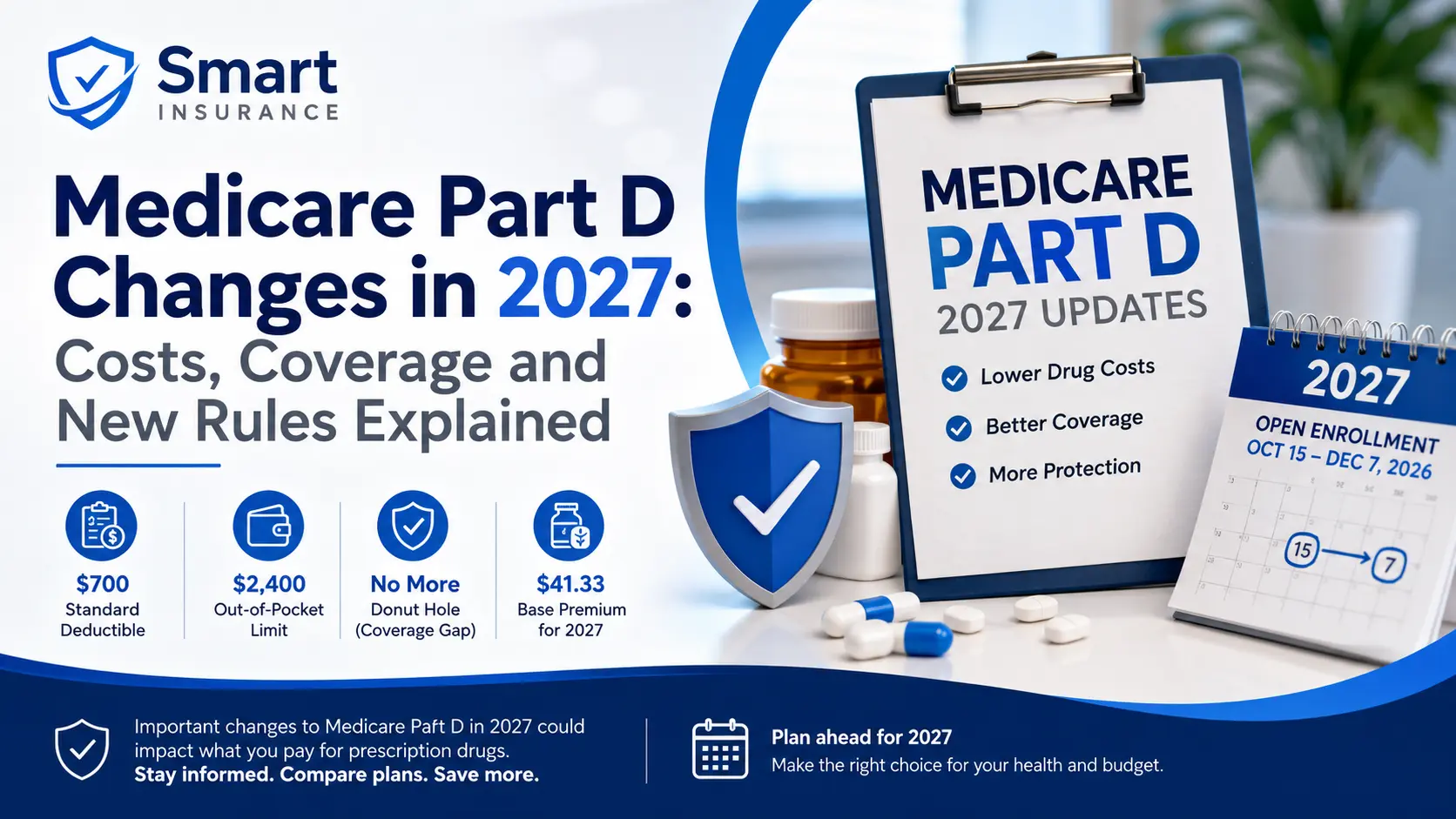
Medicare Part D changes in 2027 will affect what many beneficiaries pay for prescription drugs, how the benefit is structured, and how plans are priced. The biggest changes are already clear: the standard deductible rises to $700, the annual out-of-pocket threshold becomes $2,400, and the coverage gap, often called the “donut hole,” is eliminated as a separate coverage phase.
There is also an important premium distinction. CMS has set the 2027 national base beneficiary premium at $41.33, but that is a calculation starting point, not a guarantee that every person with Part D will pay $41.33 per month. Actual premiums vary by plan, location, and beneficiary circumstances, and CMS says final 2027 plan offerings and average premiums will be released in September.
What Are the Medicare Part D Changes in 2027?
The main Medicare Part D changes for 2027 are higher standard benefit thresholds, elimination of the separate coverage-gap phase, zero cost sharing after the annual out-of-pocket threshold, and formal codification of major Inflation Reduction Act changes. CMS finalized these provisions for 2027 and beyond.
For most beneficiaries, the practical issue is not simply that one number goes up or down. The structure of the Medicare prescription drug benefit is changing around the way costs accumulate.
The key 2027 changes include:
- Standard Part D deductible: $700, up from $615 in 2026.
- Annual out-of-pocket threshold: $2,400, up from $2,100 in 2026.
- Initial coverage cost sharing: generally 25% for covered drugs under the defined standard benefit after the deductible.
- Coverage gap: eliminated as a separate phase.
- Catastrophic phase: beneficiaries have no cost sharing after reaching the annual out-of-pocket threshold.
- Base beneficiary premium: $41.33 for 2027, used as part of the statutory formula rather than as a universal plan premium.
These numbers describe the standard benefit. Individual Medicare Part D prescription drug plans can have different premiums, formularies, pharmacy networks, utilization rules, and supplemental coverage.
Medicare Part D 2027 Costs: What Will You Actually Pay?
Your 2027 Part D cost will depend on more than the monthly premium. You may pay a plan premium, a deductible, prescription cost sharing, and potentially an income-related adjustment if you are subject to Part D IRMAA. Your own medication list and the plan’s formulary can have a major effect on the final bill.
CMS’s 2027 standard benefit parameters show how the basic structure changes:
| Part D cost | 2026 | 2027 |
| Standard deductible | $615 | $700 |
| Annual out-of-pocket threshold | $2,100 | $2,400 |
| Initial coverage cost sharing | 25% | 25% |
| Separate coverage-gap phase | No | No |
| Cost sharing after catastrophic threshold | $0 | $0 |
| National base beneficiary premium | $38.99 | $41.33 |
The $700 deductible means a beneficiary using the standard benefit could have more initial drug spending before standard coinsurance begins. At the same time, the $2,400 annual threshold limits the amount of qualifying out-of-pocket spending required before catastrophic coverage begins.
The $41.33 base beneficiary premium is not the same thing as the premium on every Medicare drug plan. CMS uses it as the starting point for calculating plan-specific basic premiums. Final 2027 plan premiums and offerings are expected in September 2026.
This distinction matters because comparing plans based only on a national premium number can produce the wrong conclusion. A plan with a lower monthly premium may have a formulary that costs you more for the medications you actually take.
That is the same basic principle that applies to broader insurance decisions: your total exposure matters more than one headline price. Smart Insurance Reviews also explains the difference between premiums, deductibles, and other expenses in its coverage of health insurance out-of-pocket costs.
How the $700 Medicare Part D Deductible Works in 2027
The standard Medicare Part D deductible rises from $615 in 2026 to $700 in 2027. Under the defined standard benefit, beneficiaries generally pay the full negotiated cost of covered drugs until they satisfy the deductible, although particular plans can structure their benefits differently within Medicare rules.
A simple example makes the change easier to understand.
Suppose your plan applies the standard deductible and you have $500 in covered prescription spending subject to the deductible. You would still have $200 remaining before reaching the $700 deductible. Once the deductible is satisfied, covered drugs generally move into the initial coverage phase, where standard cost sharing is 25%.
Your actual plan could differ because some Part D plans offer deductible exemptions or different deductibles for certain tiers of drugs. That is why checking the plan’s Summary of Benefits and formulary is more useful than assuming every prescription will follow one identical pricing path.
A larger deductible also does not automatically mean your total annual cost will be higher. If a plan has a higher premium but much lower medication costs for your prescriptions, it could still be cheaper over the full year.
What Happened to the Medicare Part D Donut Hole in 2027?
The Medicare Part D donut hole is no longer a separate coverage phase in 2027. CMS is codifying the elimination of the coverage gap as part of the Inflation Reduction Act changes to the Part D benefit.
Historically, beneficiaries moved through different Part D benefit stages, including an initial coverage period and a coverage gap. The redesigned benefit removed the separate coverage-gap phase.
That means the old idea of reaching a “donut hole” where the rules suddenly changed should no longer be used to describe the 2027 standard benefit.
The change is especially relevant for people taking expensive medications. Instead of thinking about a separate coverage-gap phase, beneficiaries should focus on:
- The plan’s monthly premium.
- The deductible.
- Each medication’s formulary tier.
- Copayments or coinsurance before reaching the annual threshold.
- The $2,400 annual out-of-pocket threshold.
- What happens after that threshold is reached.
CMS says the 2027 rule formally codifies the elimination of the coverage gap and the redesigned Part D structure created under the Inflation Reduction Act.
What Is the Medicare Part D $2,400 Out-of-Pocket Maximum in 2027?
For the 2027 defined standard benefit, the annual out-of-pocket threshold is $2,400. Once a beneficiary reaches the applicable threshold through qualifying out-of-pocket spending, the catastrophic phase begins and the beneficiary has no cost sharing for covered Part D drugs under the standard benefit.
This does not mean every dollar you spend on prescription drugs automatically counts toward the threshold.
Medicare’s rules use specific calculations for true out-of-pocket costs, and CMS is also updating those calculations for 2027.
For someone with expensive prescriptions, the annual threshold can be more meaningful than a plan’s advertised premium.
For example, a beneficiary who takes several high-cost medications may prefer a plan with a somewhat higher monthly premium if that plan provides better formulary placement and lower cost sharing for those drugs. The best plan is not necessarily the one with the cheapest premium.
How Will Medicare Part D Premiums Change in 2027?
CMS has set the 2027 national base beneficiary premium at $41.33, compared with $38.99 in 2026. That is an increase of $2.34 per month, or about 6%, but it should not be confused with the actual premium every beneficiary will pay.
Part D premiums are plan-specific. Your premium can also be affected by your income if you owe a Part D income-related monthly adjustment amount.
CMS says the 2027 base beneficiary premium is calculated through a statutory formula and serves as the starting point for plan-specific basic premiums. The agency plans to publish the final 2027 Part D plan landscape and final average premiums in September 2026.
So, as of August 20, 2026, it would be misleading to tell every Medicare beneficiary that their 2027 Part D premium will be $41.33.
What About Medicare Part D Income Limits in 2027?
There is no single income limit that determines whether someone can have Medicare Part D. Higher-income beneficiaries can pay an additional Part D income-related monthly adjustment amount, while lower-income beneficiaries may qualify for Extra Help.
The exact 2027 income-related thresholds and amounts should be checked against the final CMS figures for the 2027 benefit year rather than relying on older 2026 numbers.
Extra Help is different from the high-income adjustment. Extra Help is designed to lower prescription drug costs for people with limited income and resources. Medicare says the program can help with Part D premiums, deductibles, coinsurance, and other drug costs.
Medicare Part D Extra Help in 2027
Extra Help can reduce Medicare prescription drug costs for people with limited income and resources. Depending on eligibility, the program can help with premiums, deductibles, coinsurance, and other Part D expenses. Some people qualify automatically, while others need to apply.
This matters because a beneficiary should not assume that a change in the standard Part D benefit will determine their entire prescription budget.
Extra Help recipients can have much lower drug costs than beneficiaries paying the standard benefit. Medicare also advises people who qualify for Extra Help to review their plan options because the program does not eliminate the need to choose appropriate drug coverage.
Income and resource limits can change annually. For a 2027 decision, use the current Medicare and Social Security eligibility information rather than applying 2026 thresholds without checking.
Will Prescription Drug Coverage Be Better in 2027?
The redesigned Part D benefit provides stronger financial protection for beneficiaries with significant prescription drug spending, but coverage quality still depends heavily on the individual plan. A lower out-of-pocket ceiling does not mean every prescription becomes inexpensive.
Two plans can have similar premiums and very different costs at the pharmacy because of:
- Drug formulary placement
- Tier structure
- Preferred pharmacy networks
- Prior authorization
- Quantity limits
- Step therapy
- Generic and biosimilar availability
- Copayment and coinsurance rules
The Medicare drug formulary should therefore be one of the first things you check before switching plans. Look up every prescription you currently use and confirm the dosage and tier.
A plan that looks excellent on a premium comparison can become expensive if one of your regular brand-name drugs sits on a high-cost tier.
What Medicare Beneficiaries Should Check Before 2027
Medicare Open Enrollment runs from October 15 through December 7, and changes made during that period generally take effect January 1 of the following year. Beneficiaries in Original Medicare can join, drop, or switch Medicare drug plans during this period.
Before choosing a 2027 Medicare prescription drug plan, check:
1. Your current medications.
Make a list of every prescription, including dosage and frequency. Do not compare plans using only one or two medications.
2. The formulary.
Confirm every drug is covered and check the tier assigned to it.
3. The pharmacy network.
A plan can have favorable drug pricing but become less attractive if your preferred pharmacy is out of network or not considered preferred.
4. Total annual cost.
Add premiums, deductible exposure, prescription cost sharing, and potential out-of-pocket spending. Comparing only monthly premiums can hide the real cost.
5. Coverage changes for 2027.
Read your Annual Notice of Change. Medicare says costs and benefits can change each year, so keeping the same plan does not necessarily mean keeping the same price or coverage.
6. Extra Help eligibility.
If your income or resources have changed, check whether you qualify for assistance with Medicare prescription drug costs.
For people also comparing other senior coverage, Smart Insurance Reviews has coverage on dental insurance options for seniors on Medicare, which can help separate prescription coverage decisions from other insurance needs.
Medicare Part D Changes 2027 vs. 2026
The most useful way to understand the new rules is to compare the two years directly.
| Feature | 2026 | 2027 |
| Standard deductible | $615 | $700 |
| Annual OOP threshold | $2,100 | $2,400 |
| Standard initial cost sharing | 25% | 25% |
| Separate donut-hole phase | Eliminated | Eliminated |
| Cost sharing after catastrophic threshold | $0 | $0 |
| Base beneficiary premium | $38.99 | $41.33 |
| Part D Premium Stabilization Demonstration for standalone PDPs | In effect | Ends after 2026 |
CMS says the voluntary Premium Stabilization Demonstration for standalone prescription drug plans will end after 2026, returning the market to traditional conditions for 2027.
That development is another reason not to assume a 2026 plan will have the same premium or benefit design in 2027.
What These Changes Mean for Different Beneficiaries
Not everyone will experience the 2027 changes in the same way.
| Beneficiary situation | What may matter most |
| Few prescriptions | Monthly premium and deductible |
| Several generic prescriptions | Formulary and preferred pharmacy pricing |
| Multiple brand-name drugs | Drug tiers, coinsurance, and annual OOP threshold |
| Very expensive medications | $2,400 annual OOP threshold and catastrophic coverage |
| Limited income/resources | Extra Help eligibility |
| High income | Part D income-related adjustment |
| Changing plans | Formulary, pharmacy network, premium, and annual benefit changes |
Someone who takes only one low-cost generic medication may notice little difference from the redesigned benefit. A beneficiary taking several expensive medications could see the annual out-of-pocket protection become much more important.
That is why Medicare Part D plan selection should be based on your medication list, not a national ranking or premium alone.
When Should You Choose a 2027 Part D Plan?
The regular Medicare Open Enrollment window is October 15 through December 7, 2026, for coverage changes taking effect January 1, 2027. This is the main period to compare and switch Medicare drug plans for the coming year.
October is a good time to start the comparison because the plan information for 2027 will be available by then.
Do not wait until December simply because the deadline is December 7. A careful comparison takes longer when you have several prescriptions, use multiple pharmacies, or need to check coverage restrictions.
Your current plan can continue into 2027, but that does not mean its premium, deductible, formulary, or cost sharing will remain unchanged.
For broader health coverage changes during the same period, Smart Insurance Reviews also tracks ACA Open Enrollment changes for 2027, although ACA Marketplace enrollment and Medicare enrollment are separate programs.
The Bottom Line on Medicare Part D in 2027
The Medicare Part D changes in 2027 reshape both the cost structure and the way beneficiaries should compare prescription drug plans. The standard deductible rises to $700, the annual out-of-pocket threshold becomes $2,400, and the coverage gap remains eliminated rather than returning as a separate phase. Catastrophic coverage also has no beneficiary cost sharing under the standard benefit.
CMS has also set the 2027 base beneficiary premium at $41.33, but that number is only a starting point for calculating plan-specific premiums. Final plan premiums and benefit details are expected in September 2026, before the October 15–December 7 Medicare Open Enrollment period.
The smartest comparison is therefore not “Which plan has the lowest premium?” It is “Which plan gives me the lowest reasonable total cost for the prescriptions I actually take?”
Check the formulary, pharmacy network, deductible, drug tiers, cost sharing, premium, and annual out-of-pocket protection before choosing coverage for 2027.
Smart Insurance Reviews provides general insurance education and does not provide individualized insurance, legal, or financial advice. Medicare rules, plan premiums, formularies, and eligibility requirements can change. For a personal coverage decision, review your plan documents and use Medicare.gov or speak with a licensed Medicare professional.
Frequently Asked Questions
What is the Medicare Part D deductible for 2027?
The standard Medicare Part D deductible is $700 in 2027, compared with $615 in 2026. Plans can have different benefit designs within Medicare rules, so your specific plan materials should be checked before estimating your prescription costs.
What is the Medicare Part D out-of-pocket maximum in 2027?
The 2027 annual out-of-pocket threshold for the defined standard Part D benefit is $2,400. After the threshold is reached, catastrophic coverage begins and there is no cost sharing for covered Part D drugs under the standard benefit.
Is the Medicare Part D donut hole gone in 2027?
Yes. The coverage gap is eliminated as a separate Part D benefit phase. CMS is formally codifying the change for 2027 and beyond under the Inflation Reduction Act.
How much will Medicare Part D cost per month in 2027?
There is no single monthly premium for every beneficiary. CMS set the national base beneficiary premium at $41.33 for 2027, but actual plan premiums vary. CMS says final Part D plan offerings and average premiums will be released in September 2026.
Does everyone pay the $700 Part D deductible?
No. The $700 figure is the standard defined-benefit deductible. Individual plans can structure deductibles differently, including different treatment by drug tier. Review the specific plan’s benefit information before assuming every prescription will be subject to the same deductible.
Can Extra Help reduce Part D drug costs in 2027?
Extra Help can reduce Medicare prescription drug costs for eligible people with limited income and resources. The program can help with Part D premiums, deductibles, coinsurance, and other costs. Eligibility rules and amounts can change, so current Medicare information should be used for 2027 decisions.
When can I change my Medicare Part D plan for 2027?
Medicare Open Enrollment runs from October 15 through December 7, 2026. During this period, people with Original Medicare can join, drop, or switch Medicare drug plans, with changes generally taking effect January 1, 2027.