
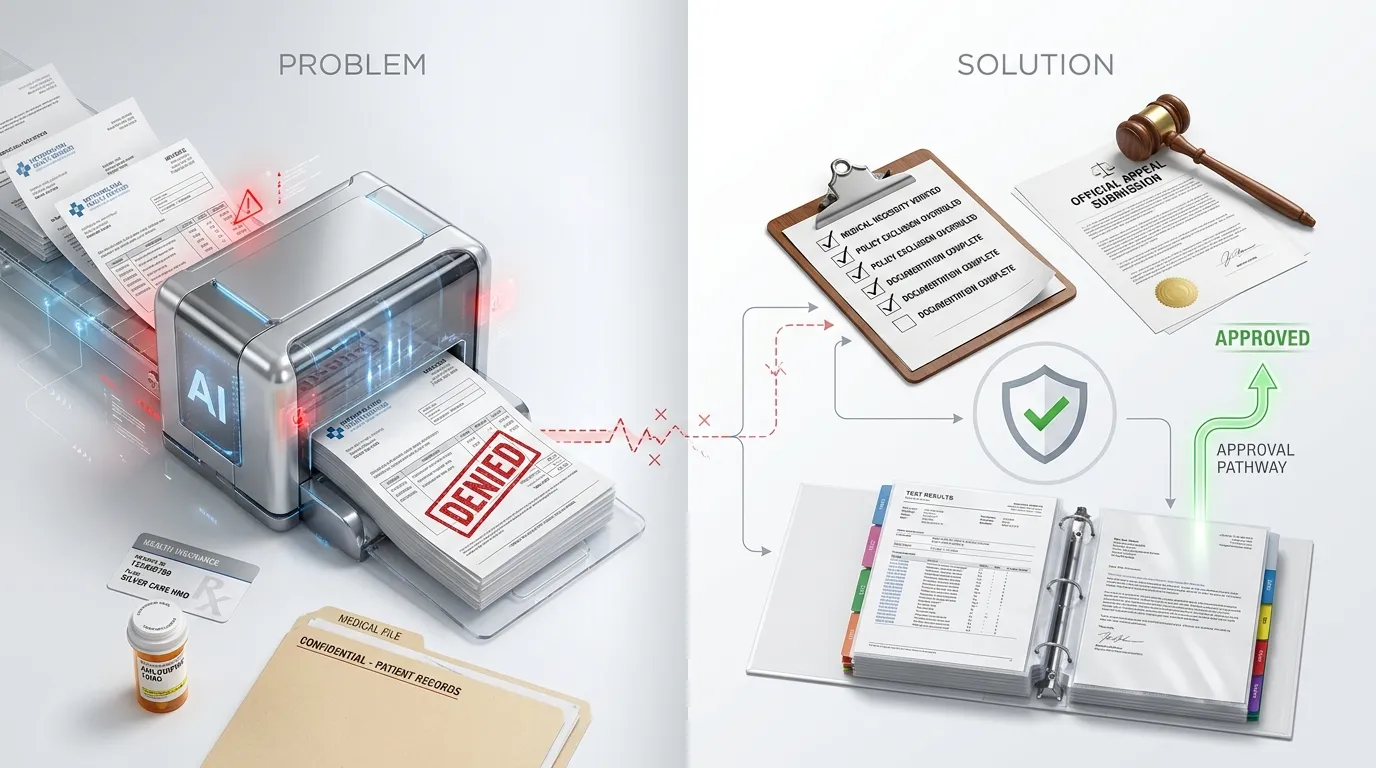
Quick Answer: Health insurers increasingly use artificial intelligence to help review and deny medical claims. Cigna and UnitedHealth both face active lawsuits alleging their AI systems improperly denied care, though neither case has been decided. A growing number of states now require a human clinician to review any AI-flagged denial before it can stand. If you believe an algorithm denied your claim, you have the right to ask who reviewed it and to appeal.
A denial letter used to mean a person somewhere reviewed your case and disagreed with your doctor. Increasingly, the first review is not a person at all. Insurers now use algorithms to help decide whether a claim gets paid, and patients are starting to notice.
Our research team reviewed federal court filings, KFF’s analysis of AI use in claims review, and 2026 state legislative records to explain what is actually happening, what remains an unproven allegation, and what you can do if you suspect an algorithm was involved in your own denial.
How AI Actually Gets Used in Claims Decisions
Insurers use AI in two different stages, and the distinction matters. Prior authorization review happens before you receive care, when an insurer decides whether a planned treatment will be covered. Post-service claims review happens after care has already been delivered, when the insurer decides whether to pay the bill.
According to KFF’s review of insurer AI use, algorithms can assist in both stages by scanning clinical documentation against coverage criteria and flagging cases for approval or denial. Many insurers state that a licensed clinician makes the final call. Lawsuits filed against two major insurers allege that in practice, human review was minimal or absent for a significant share of denials.
The Two Lawsuits Behind the Headlines
Two active federal cases are driving most of the current concern about AI and claims denials. Neither has been resolved, and both insurers dispute key allegations.
In Kisting-Leung v. Cigna Corp., filed in the Eastern District of California in July 2023, patients allege that Cigna used an algorithm called PxDx to allow company doctors to reject batches of claims without reviewing individual patient files, thereby bypassing the physician review required under California law. A federal judge allowed the case to proceed in March 2025, though plaintiffs were required to amend parts of their complaint. Cigna has publicly stated that PxDx does not use AI and describes it as similar to review software other insurers and Medicare have used for years, applied to a limited set of low-cost tests and procedures.
In the Estate of Lokken v. UnitedHealth Group case, filed in Minnesota in November 2023, families of deceased Medicare Advantage beneficiaries allege UnitedHealth used an algorithm called nH Predict to cut off coverage for skilled nursing and rehabilitation care based on predicted recovery timelines rather than individual patient needs. In February 2025, a federal judge dismissed several counts on Medicare preemption grounds but allowed breach of contract claims to proceed, meaning the case continues on a narrower legal theory.
Both cases remain open. The allegations describe how plaintiffs say the systems were used, not a court’s final finding of fact.
What the Data Actually Shows About Denial Rates

Separate from the lawsuits, federal data shows overall claim denials have been elevated in recent years. KFF’s analysis of Affordable Care Act marketplace plans found insurers denied about 19 percent of in-network claims in 2023, the most recent year available at the time of that study. Fewer than 1 percent of denied claims were appealed, and insurers upheld their own denial in 56 percent of the appeals that were filed.
A separate U.S. Senate Permanent Subcommittee on Investigations report found that UnitedHealthcare’s denial rate for post-hospital care more than doubled between 2020 and 2022, around the same period the company expanded its use of automated review tools. This finding comes from a congressional investigation, not from the pending lawsuits, and it describes a correlation in timing rather than a proven cause. Readers should also treat older company-specific denial rate figures with caution. A widely repeated statistic citing a 33 percent UnitedHealthcare denial rate reflects earlier data and should not be treated as this insurer’s current rate without checking the year it applies to.
States Are Stepping In
State legislatures have moved faster than federal regulators on this issue. As of mid 2026, at least a dozen states have passed laws requiring a licensed human clinician to review any claim denial where AI played a role, rather than letting an algorithm’s recommendation stand on its own.
| State | Requirement |
|---|---|
| California | AI-assisted utilization review must be based on individual clinical history (effective 2025) |
| Texas | Prohibits AI as the sole basis for an adverse coverage determination |
| Indiana | Bars AI as the sole basis for downcoding a claim without clinician review (effective July 2026) |
| Arizona, Maryland, Nebraska, Alabama, Washington | Require human physician oversight of AI-driven denials |
| Minnesota | Bill barring AI as the sole basis for a prior authorization denial passed the legislature in May 2026 and was awaiting the governor’s signature. |
Separately, at least 25 states have issued guidance based on a 2023 model bulletin from the National Association of Insurance Commissioners, which requires insurers to document how they monitor AI systems used across claims and underwriting. This list will keep growing. Confirm your own state’s current status before relying on it for an appeal.
Why This Matters for You as a Patient
A faster claims process sounds like a benefit until the speed comes from skipping the individualized review your policy is supposed to guarantee. When an algorithm flags a denial without a clinician reading your specific medical records, you may be fighting a decision that never actually considered your case.
This is also a disclosure problem. Patients are often not told an algorithm was involved at all. A 2026 Health Affairs study by Stanford researchers found that many AI systems used in coverage decisions lack the governance needed to monitor their own accuracy, meaning wrongful denials can occur and go uncorrected unless a patient pushes back.
How to Tell If AI Was Involved in Your Denial
A few patterns suggest algorithmic involvement, though insurers do not always disclose this directly.
- The denial arrived unusually quickly after you or your provider submitted the claim.
- The denial letter uses generic language tied to billing codes rather than any specific detail from your medical records.
- The letter does not name a specific reviewing clinician.
Under most state and federal rules, you can request in writing the name and credentials of whoever reviewed your denial. If the insurer cannot name a clinician who read your actual file, that is worth raising directly in your appeal.
What to Do If You Think an Algorithm Denied Your Claim
- Request your denial letter’s specific reason code and ask in writing for the name and credentials of the reviewing clinician.
- Check whether your state requires human review of AI-assisted denials, and cite that law directly in your appeal if it applies.
- File your internal appeal before the deadline stated in your denial letter, typically within 180 days.
- Include your doctor’s original clinical notes and a letter of medical necessity, since these are often what an automated first review skipped.
- If the internal appeal fails, request an external review through your state insurance department or the federal process.
These steps apply whether or not the specific system involved in your case is ever disclosed. Patients managing a denial on top of already rising costs may also want to review what they can expect to pay out of pocket and how denial rates vary by insurer before their next enrollment period.
Frequently Asked Questions

Is it legal for an AI to deny my health insurance claim?
Rules vary by state. A growing number of states now require a licensed clinician to review any denial where AI played a role, meaning an algorithm generally cannot be the sole basis for a final denial in those states. Where no such law exists yet, the legal boundaries are still being tested in active court cases.
Which companies are being sued over AI claim denials?
Cigna and UnitedHealth both face active federal lawsuits alleging improper use of algorithms in claims decisions. Both cases remain open and unresolved, and both companies dispute significant parts of the allegations against them. No court has issued a final ruling on the merits of either case.
Does my state require a human to review AI denials?
At least a dozen states, including California, Texas, Indiana, Arizona, Maryland, Nebraska, Alabama, and Washington, have passed some form of human review requirement as of 2026. Check your state insurance department’s current guidance, since more states are considering similar bills.
Do AI-flagged denials get overturned on appeal?
Overall appeal data shows insurers uphold their own denial in the majority of cases that reach a formal appeal, though administrative and process-based denials tend to be the easiest to resolve. Specific reversal rates tied to particular AI systems are currently disputed allegations in ongoing litigation rather than independently confirmed figures.
Will insurers have to disclose when AI was used in my denial?
Several state laws now require disclosure when AI or an algorithm played a role in a coverage decision. Requirements vary by state, and a national disclosure standard does not currently exist. Ask your insurer directly and request it in writing if you suspect algorithmic involvement.
The Bottom Line
AI is a real and expanding part of how health insurers process claims, and the legal fight over where that crosses a line is still being decided in court. What is not in dispute is that patients have appeal rights, a growing number of states now require human review of algorithm-flagged denials, and persistence through the appeal process remains the most reliable tool available right now.
This content is general information only and is not legal advice. Litigation described here involves active, unresolved cases, and the allegations discussed have not been proven in court. State laws referenced change frequently. Consult your state insurance department or a licensed attorney for guidance on your specific situation.