
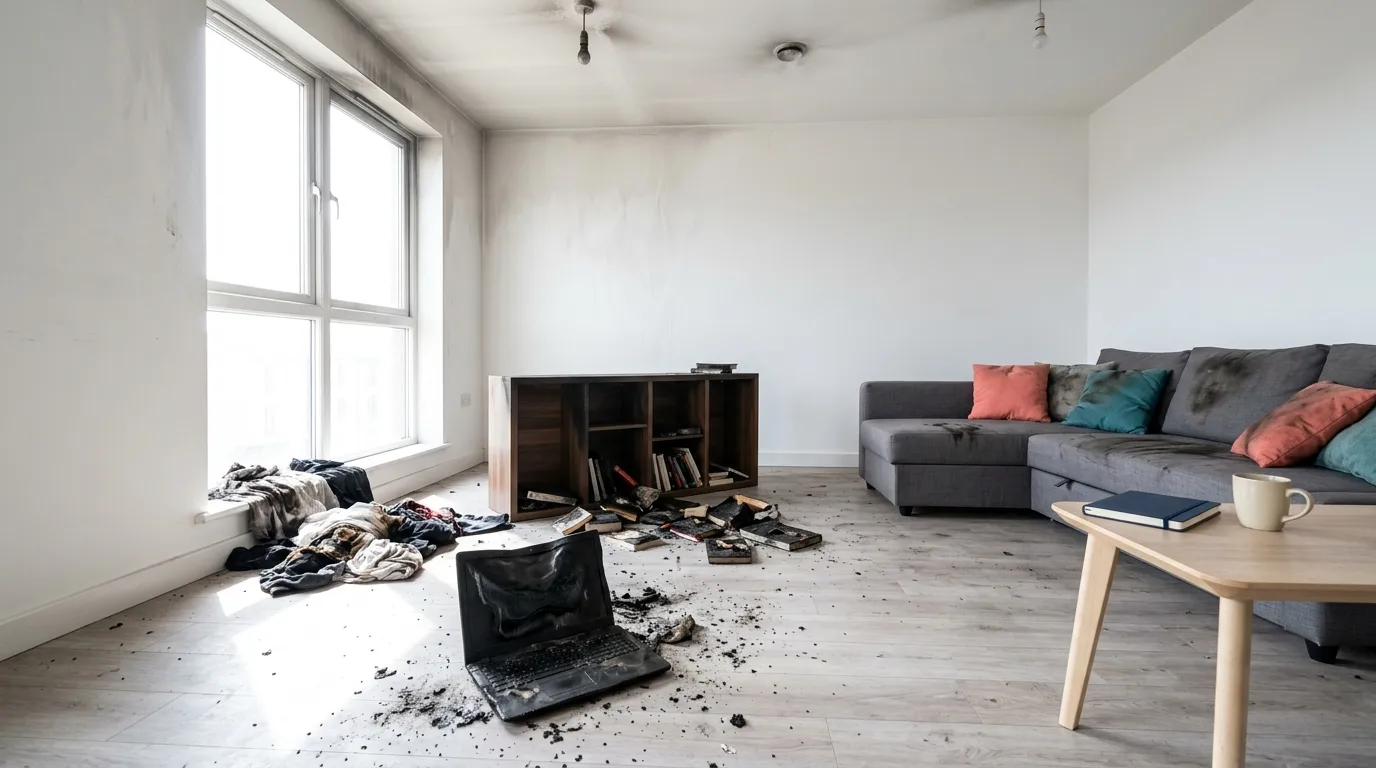
A renters insurance quote takes four minutes online and costs nothing to get. The average policy runs 14 dollars per month. It covers personal belongings, liability, and hotel costs if your unit becomes uninhabitable. A renter without a policy absorbs the full replacement cost of their belongings, and the contents of a typical apartment commonly run well into five figures.
In an illustrative scenario based on industry loss data, a tenant on the third floor of an apartment building lost everything in 11 minutes. The fire started in the unit directly above hers. By the time she reached the street, her laptop, her furniture, her clothing, and four years of belongings were gone.
The damage totaled 18,000 dollars in personal property. She had nowhere to sleep for three months. Hotel costs ran 1,800 dollars per month. Her total out of pocket loss came to 23,400 dollars.
She had no coverage. A quote on the carrier that covered her neighbor would have taken four minutes online and cost 14 dollars per month. That 14 dollars covered everything. The neighbor paid zero beyond a 500 dollar deductible.
The financial gap that opens when a tenant loses everything without a policy is well documented in industry claims data, and it is far larger than the premium most renters decline to pay. Below: the exact four minute quoting process, and which carriers complete it online without a phone call. It also shows what coverage pays in a real loss and how to find affordable coverage for apartments without cutting the protection that matters.
What the Landlord Policy Does Not Cover
This is where most tenants get it wrong. They assume their landlord carries insurance and that some of it protects them. It does not.
A landlord policy covers the building. It covers the walls, the roof, the plumbing, the electrical system, and fixtures that came with the unit. It covers the financial interests of the property owner. Nothing in that policy covers a single item you own, pays for your hotel room after a fire, or defends you if a guest is injured inside your unit.
Here is exactly what the property owner policy covers and what it leaves completely uncovered for you.
| Coverage Category | Landlord Policy | Tenant Exposure |
|---|---|---|
| Physical structure including walls, floors, and roof | Covered | Not applicable |
| Building systems including plumbing, HVAC, and electrical | Covered | Not applicable |
| Personal belongings including furniture, electronics, and clothing | Not covered | Fully exposed |
| Hotel and temporary housing costs after a fire | Not covered | Fully exposed |
| Liability if a guest is injured inside your rented unit | Not covered | Fully exposed |
About 47 percent of U.S. renters carry no coverage at all, per NAIC 2025 consumer data. That leaves roughly 20 to 25 million renter households fully exposed. A single apartment fire produces an average loss of 13,000 dollars to 15,000 dollars in personal property once you include all damaged and smoke affected items, and 3,000 dollars to 5,000 dollars per month in displacement costs, according to 2025 claims data.
That is the financial gap a quote closes. For 14 dollars per month.
What Standard Coverage Pays During a Claim
Before you request a quote, you need to understand what the coverage pays. Most guides list coverage types as vague bullet points. Here is what each line means in a real claim situation, with actual dollar figures.
| Coverage Type | What It Pays For | Typical Limit | Real Claim Example |
|---|---|---|---|
| Personal property | Replaces belongings after theft, fire, or covered damage | 20,000 to 50,000 dollars | Laptop, phone, furniture after apartment fire: 18,000 dollars |
| Liability | Legal costs and medical bills if a guest is injured in your unit | 100,000 to 300,000 dollars | Guest slips, breaks wrist, sues for 45,000 dollars: covered |
| Additional living expenses | Hotel and food costs while your unit is uninhabitable | 20 to 30% of personal property limit | 3 months hotel at 1,800 dollars per month: 5,400 dollars covered |
| Medical payments to others | Immediate medical costs for guests injured in your unit | 1,000 to 5,000 dollars | Visitor cuts hand on broken glass: 800 dollar ER bill covered |
Now the detail that most carriers bury on page three of the form.
Every form asks one question that will determine your payout more than any other: actual cash value or replacement cost for personal property?
Actual cash value pays what your belongings are worth today after depreciation. A MacBook you bought three years ago for 1,200 dollars is worth around 500 dollars today. That is what actual cash value pays after a theft.
Replacement cost pays what it costs to buy the equivalent new model right now. The premium difference between the two is typically 3 to 6 dollars per month. Every renter who chooses actual cash value without understanding this comparison is making a 700 dollar decision to save 4 dollars a month.
Choose replacement cost. Every time.
Now the second number most renters never look at. The liability limit.
The default on most forms is 100,000 dollars. A single slip and fall lawsuit inside a rented apartment that proceeds to judgment routinely reaches 40,000 dollars to 150,000 dollars when you count medical costs, legal fees, and damages. Raising your limit from 100,000 dollars to 300,000 dollars adds between 1 dollar and 3 dollars per month to your premium. The coverage difference is 200,000 dollars. There is genuinely no good reason to leave the default in place.
The Exact Four Minute Quoting Process
This is the section most guides skip. They tell you to shop around and leave you with a carrier list. Here is the actual process, step by step, on any major carrier platform.
- Have four things ready before you open any carrier site. Your rental address, an estimate of your total personal property value, your preferred deductible amount, and whether you want actual cash value or replacement cost. This preparation takes two minutes. Without it, the process will stall and take 20 minutes instead of four.
- Estimate your personal property value honestly. Walk through your apartment mentally and add up replacement costs for electronics, furniture, clothing, kitchen appliances, instruments, sports equipment, and anything else you would need to replace after a fire. Most renters estimate 8,000 dollars to 10,000 dollars. The actual replacement cost of a standard one bedroom apartment typically runs 25,000 dollars to 35,000 dollars. Use 25,000 dollars as your floor unless you own very little.
- Choose between a direct carrier site and a comparison tool. A direct carrier site gives you one quote and usually completes fastest. A comparison tool gives three to five quotes at once but routes some results through affiliate links. Use a comparison tool first to see the market, then go direct to your top two results to verify the coverage details match.
- Enter your rental address. Carriers pull building age, construction type, and local crime statistics from public records automatically after you enter the address. Check every prefilled field before moving forward. Public records are sometimes outdated, especially in buildings that have been renovated.
- Set your personal property coverage to replacement cost. This is the choice from step one. Select replacement cost. Do not accept the actual cash value default without reading what it means.
- Set your liability limit to 300,000 dollars. Change the default 100,000 dollars to 300,000 dollars before comparing any premiums. This costs 1 dollar to 3 dollars more per month and doubles the protection.
- Save the quote as a PDF before closing the browser. Online quotes expire in 15 to 30 days depending on the carrier. The email confirmation alone does not preserve all the coverage details you need for comparison. Save the full PDF with the coverage summary.
One thing to know about the number on the screen: it is a soft quote. A soft quote is an estimate generated instantly, before the carrier runs underwriting. The final premium at binding can change by 5 to 15 percent after you complete the full application. This is standard on every platform. Build that range into your comparison before deciding.
Carriers That Complete the Process Online Without a Callback
Six carriers complete the full process online without requiring a phone number or triggering an agent callback. Here is the current data including J.D. Power 2025 customer satisfaction scores and AM Best financial strength ratings.
| Carrier | Instant Quote | Phone Required | Avg Monthly Cost | J.D. Power (2025) |
|---|---|---|---|---|
| Lemonade | Yes | No | $5 to $25 | 746 / 1,000 |
| Progressive via Homesite | Yes | No | $14 to $30 | 791 / 1,000 |
| State Farm | Yes | Optional | $15 to $32 | 829 / 1,000 |
| GEICO via partners | Partial | Sometimes | $12 to $28 | 801 / 1,000 |
| Allstate | Yes | Optional | $16 to $35 | 829 / 1,000 |
| Liberty Mutual | Yes | No | $5 to $20 | 774 / 1,000 |
Source: J.D. Power 2025 U.S. Renters Insurance Study and AM Best ratings database.
Here is what you need to know about each carrier online process before you start.
Lemonade completes the entire process and purchase online in under five minutes with no phone number required at any point. Coverage is available in 28 states plus Washington D.C. If you are in a state Lemonade does not serve, move to Progressive or Liberty Mutual.
Progressive handles policies through its Homesite subsidiary. The process can be completed fully online without requiring a phone number. The average monthly premium runs 14 dollars to 30 dollars depending on your coverage limits and state. For a detailed breakdown of their home and renters offerings, see our home insurance quote guide.
State Farm generates a quote in under 10 minutes online. The phone number field is present but optional. Leaving it blank does not prevent the process from completing. State Farm holds the highest AM Best rating among major carriers and the highest J.D. Power customer satisfaction score in the 2025 study. Bundling with auto saves an average of 900 dollars per year per published 2025 data. See our State Farm home insurance coverage guide for their full policy structure.
GEICO routes policies through partner carriers rather than underwriting them directly. The assigned partner depends on your state. Always verify the partner carrier AM Best rating separately before binding because the rating shown belongs to GEICO, not the policy writer. Some partners complete the process without a callback. Others request a phone number for routing.
Allstate includes an optional phone number field that can trigger an agent follow up if completed. Leave it blank to skip the callback. Allstate holds an A+ AM Best rating and the same J.D. Power score as State Farm in 2025.
Liberty Mutual completes the full process online with no phone number required. For current auto customers, coverage starts at 5 dollars per month. The online process is among the fastest of the six carriers covered here.
Five Ways to Lower Your Premium Without Cutting Essential Protection
The national average cost is 151 dollars to 171 dollars per year, or 13 dollars to 14 dollars per month, for a policy with 30,000 dollars in personal property coverage and 100,000 dollars in liability, per NerdWallet 2026 rate analysis and the Insurance Information Institute.
Most renters overpay in one of two ways. Either they pay more than they need to because they never compared quotes, or they cut the wrong coverage to save 2 dollars a month and find out what that costs when they file a claim.
Here are five ways to reduce your cost without reducing the coverage that matters.
- Bundle with auto insurance. Most carriers reduce both policies by 5 to 25 percent when bundled. State Farm reports an average combined saving of 900 dollars per year on bundled policies. Progressive saves an average of 5 percent on the policy in most states when bundled with auto. This is the single largest discount available and most tenants never ask about it.
- Choose a higher deductible. Moving from a 250 dollar deductible to a 500 dollar deductible reduces most premiums by 8 to 12 percent. Only raise the deductible to an amount you could pay out of pocket tomorrow without borrowing. A 1,000 dollar deductible on a 14 dollar per month policy is not a good trade if a 600 dollar theft claim falls below it.
- Install and report security devices. Deadbolts, smoke detectors, monitored alarm systems, and water leak sensors generate discounts of 2 to 8 percent with most carriers. Enter them during the process. These discounts apply automatically when you report the devices on the form. If you install a monitored alarm after buying the policy, call the carrier and ask for the discount retroactively.
- Pay the annual premium upfront. Most carriers charge a 3 to 5 percent service fee for monthly billing. Paying the full year upfront removes that fee. At 170 dollars per year, the saving is 5 dollars to 8 dollars. Small number, but there is no reason to pay a billing fee on a policy this inexpensive.
- Get at least three quotes before buying. The same renter profile produces a 40 dollar to 80 dollar annual price spread across major carriers. Getting one quote and buying is the easiest way to overpay. Use one comparison tool and two direct carrier sites. That combination surfaces the best available rate without requiring five separate applications.
Common Mistakes Tenants Make Before a Loss
Five mistakes produce the kind of out of pocket outcome described at the top of the page. All five come from real client situations reviewed through industry claims data analysis.
1. Assuming belongings are worth less than they are.
Most renters estimate their personal property at 8,000 dollars to 10,000 dollars. The actual replacement cost of electronics, furniture, clothing, kitchen items, and appliances in a standard one bedroom apartment typically runs 25,000 dollars to 35,000 dollars. Underestimating this leads to underinsuring, which means the policy pays out less than the actual loss after a claim. The insurer pays your stated limit, not your actual loss.
2. Thinking the process takes too long.
The most common reason renters give for skipping is time. The actual process on Lemonade, Progressive, and Liberty Mutual takes four to six minutes with basic information ready. That perception gap costs the average uninsured tenant 13,000 dollars to 15,000 dollars in out of pocket loss when a covered event occurs, per 2025 claims data from The Agents Office. Six minutes versus 13,000 dollars. That is the actual trade.
3. Choosing actual cash value without understanding the payout.
Actual cash value policies cost less per month. They are also significantly worse when you file a claim. A television you bought three years ago for 800 dollars pays out 350 dollars to 400 dollars under actual cash value after depreciation. Replacement cost pays what it costs to buy the current equivalent. The premium difference is 3 dollars to 6 dollars per month. Most renters who choose actual cash value do so without reading what it means on the form.
4. Not reading the liability limit before buying.
The default liability limit on most forms is 100,000 dollars. A single slip and fall lawsuit in a rented apartment that proceeds to judgment routinely reaches 40,000 dollars to 150,000 dollars in combined medical costs, legal fees, and damages. Raising the limit to 300,000 dollars costs 1 dollar to 3 dollars more per month. Most renters scroll past this line entirely.
5. Letting the quote expire without buying.
Online quotes are valid for 15 to 30 days. Most renters who do not buy within the first 48 hours of receiving a quote do not come back. The policy costs 14 dollars per month. The average insured claim pays out 13,000 dollars to 15,000 dollars. There is no financial argument for waiting.
Frequently Asked Questions
How much does a quote cost to get?
Getting a quote costs nothing. Every carrier and comparison tool provides quotes at no charge and with no obligation to buy. The process does not affect your credit score. A soft pull runs in the background for insurance scoring purposes but does not appear on your credit report and does not change your FICO score.
What information do I need to start?
Your rental address, an estimate of your total personal property replacement value, your preferred deductible amount, and whether you want actual cash value or replacement cost. Some carriers also ask for your claims history from the past three to five years. Having these items ready before you open any carrier site cuts the average time from 12 minutes to under five.
How much does coverage cost per month?
The national average is 13 dollars to 14 dollars per month for 30,000 dollars in personal property coverage and 100,000 dollars in liability. Premiums range from 5 dollars per month for basic coverage to 35 dollars per month for high value property limits. Your location, claims history, and insurance score based on credit all affect the final number.
Does coverage protect theft outside my apartment?
Yes. Most standard policies cover theft of personal belongings outside your apartment, including items stolen from a car, a hotel room, or a storage unit. The off premises coverage limit is typically 10 percent of your total personal property limit. Check the declarations page of any policy you are considering for the exact sublimit.
What does the policy not cover?
Standard coverage does not cover flood damage, earthquake damage, pest or rodent damage, normal wear and tear, or a roommate belongings unless they are listed on the policy. Flood coverage requires a separate NFIP or private flood policy. Earthquake coverage is available as an endorsement in most states but must be added separately.
How many quotes should I get?
At minimum three. The same renter profile produces a 40 dollar to 80 dollar annual price spread across major carriers. Using one comparison tool and two direct carrier sites typically surfaces the best available rate without requiring five separate applications.
Your Next Step Takes Four Minutes
The tenant who lost 23,400 dollars did not lack information. She had not taken the four minutes to get a quote before the fire on the floor above her.
Her neighbor had. Her neighbor paid zero beyond a 500 dollar deductible.
The financial difference between those two outcomes is 14 dollars per month and one afternoon of your time.
Here is what to do right now.
- Estimate your personal property replacement value before opening any carrier site. Walk through your space mentally. Add up electronics, furniture, clothing, and kitchen items. Most renters land between 25,000 dollars and 40,000 dollars.
- Open one comparison tool and one direct carrier site. Get at least three quotes before comparing premium numbers.
- Set your personal property type to replacement cost and your liability limit to 300,000 dollars before reviewing any premium line.
- Check the AM Best rating on your chosen carrier before entering any payment details. Anything below A is worth reconsidering.
Disclaimer: This content is general education drawn from published industry claims data and rate studies, and does not replace advice from a licensed insurance agent or your state insurance department. Coverage terms, availability, pricing, and endorsement options vary by state, carrier, and individual property. Consult a licensed insurance professional for policy specific advice.