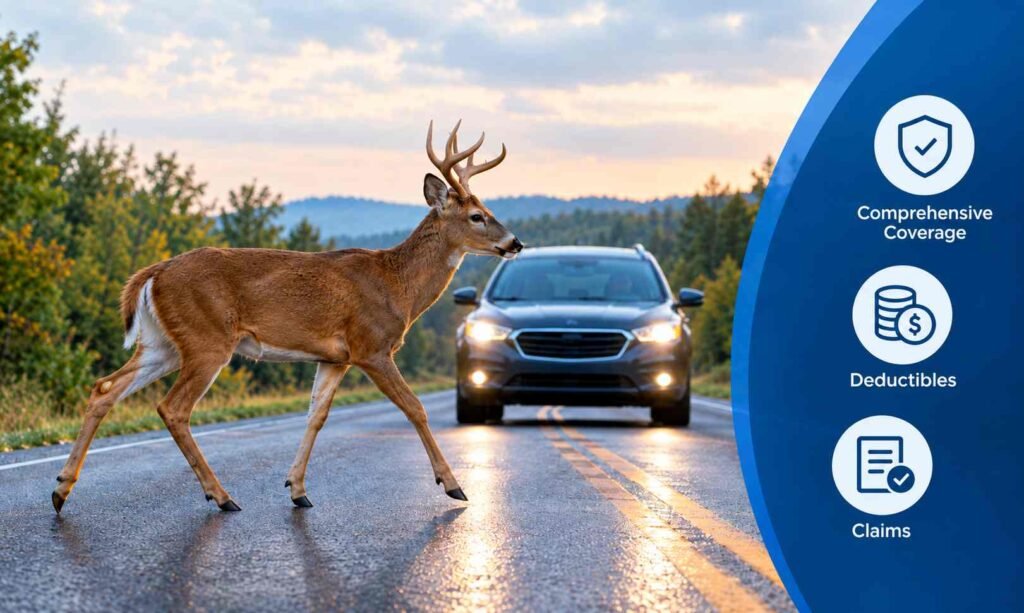
Hitting a deer can damage your car, cause injuries, and leave you wondering who will pay for the repairs. In most cases, car insurance covers damage from hitting a deer if your policy includes comprehensive coverage. However, the amount your insurer pays depends on your deductible, the extent of the damage, and the terms of your policy.
The situation can be different if you swerve to avoid a deer and hit a tree, guardrail, or another vehicle. That type of accident generally falls under collision coverage rather than comprehensive coverage.
Understanding these differences can help you decide whether to file a claim, estimate your potential out-of-pocket costs, and avoid common mistakes after an accident.
Does Car Insurance Cover Hitting a Deer?
Yes, hitting a deer is generally covered by comprehensive car insurance, provided the policy is active and the loss meets its coverage terms.
Comprehensive coverage typically pays for covered damage to your vehicle caused by events other than a collision with another vehicle or object. These events include theft, vandalism, certain weather-related damage, and contact with animals such as deer.
The Insurance Information Institute explains this distinction in its Guide to avoiding deer-car collisions.
However, not every driver has comprehensive coverage. If you have only liability insurance, your policy generally will not pay to repair your own vehicle after you hit a deer.
Your policy determines your specific coverage, exclusions, deductible, and claim requirements.
What coverage applies to different deer accident situations?
| Situation | Coverage that may apply | Important consideration |
| You hit a deer directly while driving | Comprehensive | A comprehensive deductible generally applies. |
| You swerve to avoid a deer and hit a tree | Collision | Your collision deductible generally applies. |
| You swerve and collide with another vehicle | Collision for your own vehicle; liability may apply to damage or injuries you cause | Fault and payment depend on the circumstances, policy terms, and applicable law. |
| A deer runs into your moving or parked car | Comprehensive in many standard policies | The insurer will assess the circumstances and resulting damage. |
| You have liability-only insurance | Usually no coverage for your own vehicle’s deer-related damage | Liability protects against covered claims by other people, not damage to your own car. |
| You or a passenger is injured | MedPay, PIP, health insurance, or other applicable coverage | Available benefits depend on your policy and state rules. |
This table provides general guidance, not a guarantee of coverage. The NAIC’s auto insurance guide explains the differences between liability, collision, and comprehensive insurance.
Is Hitting a Deer Comprehensive or Collision?
The main distinction is whether your vehicle directly strikes the animal or collides with another object while you try to avoid it.
Comprehensive coverage generally applies when your vehicle hits a deer. Collision coverage generally applies when your vehicle strikes another vehicle, a tree, a barrier, or another object. The insurer will evaluate the actual circumstances rather than relying only on how the incident is described.
Example: You hit a deer directly
You are driving on a rural road when a deer suddenly crosses your path. You brake, but your vehicle hits the animal and damages the bumper, grille, and headlight.
If your policy includes comprehensive coverage, the resulting vehicle damage will generally be considered under that coverage, subject to the deductible and policy terms.
Example: You swerve and hit a tree
A deer enters the road, and you turn sharply to avoid it. Your vehicle leaves the roadway and strikes a tree.
In this case, collision coverage generally applies to damage to your vehicle because it struck an object. If you have comprehensive coverage but no collision coverage, the deer-related comprehensive protection would not automatically pay for the separate collision damage.
For a broader explanation of policy options, see our guide to Full coverage car insurance.
Does Liability Insurance Cover Hitting a Deer?
Usually, no. Liability-only insurance does not generally pay for damage to your own vehicle when you hit a deer.
Auto liability coverage is primarily designed to pay covered bodily injury or property damage claims for which you are legally responsible. It is different from coverage that protects your own vehicle.
Consider these two situations:
- You hit a deer and damage your car: You would generally need comprehensive coverage for the vehicle damage.
- You swerve to avoid a deer and hit another driver’s car: Your liability coverage may pay for the other person’s covered damages if you are legally responsible. Collision coverage may apply to your own vehicle if you carry it.
If you financed or leased your vehicle, check your insurance requirements as well. A lender or leasing company may require comprehensive and collision coverage even though these protections are generally optional under state insurance laws.
Do You Pay a Deductible After Hitting a Deer?
In most cases, you must pay the comprehensive deductible stated in your policy before your insurer pays for covered repairs.
Your deductible is the portion of a covered loss that you pay out of pocket. The insurer generally pays the remaining eligible amount, subject to policy limits, exclusions, and claim adjustments.
Deer collision deductible example
Suppose your car sustains $2,500 in covered damage after hitting a deer.
| Item | Amount |
| Approved covered repair cost | $2,500 |
| Comprehensive deductible | $500 |
| Potential insurance payment | $2,000 |
| Your share of the repair cost | $500 |
These figures are illustrative. The actual payment may differ depending on the insurer’s damage assessment, policy terms, and any additional covered expenses.
Now suppose your covered repairs cost $400 and your deductible is $500. If no other covered expenses apply, there may be no insurance payment because the damage is below your deductible.
How to decide whether the claim is worth considering
Before filing a claim for minor damage, compare the following:
- The estimated repair cost: Obtain a reliable estimate that accounts for visible damage and any necessary inspection.
- Your deductible: Check the comprehensive deductible on your declarations page.
- Potential additional damage: A damaged bumper or grille may conceal damage to components behind it.
- Your policy and claims history: Ask your insurer how the claim will be handled and whether it could affect future premiums.
Do not assume that every deer collision requires an insurance claim or that every claim increases your premium. The financial decision depends on the size of the loss, your coverage, and your insurer’s rules.
For more detail about animal-related protection and its potential costs, read our guide on Whether comprehensive car insurance is worth it.
Should You File an Insurance Claim After Hitting a Deer?
Filing a claim may make sense when the repair cost substantially exceeds your deductible, the damage is severe, or the vehicle may be unsafe to drive.
Paying out of pocket may be worth considering when the damage is minor, and the repair estimate is close to or below your deductible. However, review your policy’s reporting requirements before deciding not to report an incident.
Use this framework to organize your decision:
- Damage below your deductible: The claim may not produce an insurance payment for vehicle repairs.
- Damage moderately above your deductible: Compare the potential payment with your repair costs and consider any possible effect on your insurance history.
- Major damage or possible total loss: Contact your insurer promptly and follow the claim process.
- Possible hidden damage or safety concerns: Arrange an appropriate inspection rather than relying only on the visible damage.
You should not delay reporting a serious incident merely to avoid a possible rate increase. Prompt communication can help you understand your obligations and preserve relevant evidence.
If an insurer disputes or denies a claim, review the written explanation and the applicable policy provisions. Our guide to Car insurance claim denials explains general steps to take when a payment is disputed.
Will Insurance Rates Go Up After Hitting a Deer?
Your premium may change after a deer collision, but there is no universal rule that every deer claim will increase your car insurance rates.
A direct deer impact is generally handled under comprehensive coverage rather than collision coverage. However, the way an insurer treats the incident for rating purposes can depend on the insurer’s underwriting rules, your state, your claims history, and any applicable accident-forgiveness provisions.
Before making assumptions about the effect on your premium, ask your insurer:
- How will the incident be classified?
- Could this type of claim affect my renewal premium?
- Does my policy include any applicable accident-forgiveness benefit?
- Are there state-specific rules affecting how the claim can be rated?
Accident forgiveness should not be treated as automatic protection. Its availability and terms vary, and a particular benefit may not apply to every type of claim.
Your insurer is the best source for policy-specific information. You can also consult your state insurance department about applicable consumer protections and rating rules.
What Happens If You Swerve to Avoid a Deer and Crash?
Swerving to avoid a deer can lead to a different insurance outcome from hitting the animal directly.
If your vehicle strikes a tree, guardrail, or another vehicle, collision coverage generally applies to your own vehicle’s damage if you carry that coverage and the loss is covered.
If another driver or their vehicle is involved, the insurer may also need to examine the circumstances to determine responsibility for covered damages. Liability questions depend on the facts and applicable state law.
The Insurance Information Institute advises drivers to brake firmly while remaining in their lane when possible, rather than making a sudden evasive maneuver that could cause a more serious crash. See its Deer collision safety guidance.
Driver safety comes first. Do not risk a severe collision simply to avoid an animal.
What to Do After Hitting a Deer
Knowing what to do immediately after an accident can help protect you, other road users, and the evidence needed for an insurance claim.
1. Move to a safe location if possible
Slow down, activate your hazard lights, and move out of traffic if it is safe to do so. If the car cannot be moved safely, remain aware of surrounding traffic and seek assistance.
Call emergency services if someone is injured or there is an immediate danger.
2. Do not approach the deer
An injured or frightened deer may behave unpredictably and cause further injury. Do not attempt to touch, move, or treat it yourself.
If the animal is blocking the roadway or creating a traffic hazard, contact local law enforcement or the appropriate local authority.
3. Document the incident
When it is safe, record the information that may help support your claim:
- Photographs of the vehicle’s damage from several angles.
- Pictures of the road and surrounding area, where safe and appropriate.
- The date, time, and location of the collision.
- A description of what happened.
- Contact information for any witnesses, if available.
- Any incident or police report reference number, if one was created.
Do not put yourself in danger to collect photos or evidence.
4. Contact your insurer
Use your insurer’s official claims number or online claims portal. Explain what happened, describe the visible damage, and ask which coverage applies.
Confirm your deductible and ask whether the insurer needs to inspect the vehicle before repairs begin. Follow the company’s instructions for photographs, estimates, inspection, and documentation.
5. Arrange an inspection and repair estimate
Visible damage may not show the full extent of a collision. Depending on where the deer struck your vehicle, an inspection may identify damage to the radiator, headlights, grille, cooling system, or driver-assistance sensors.
Ask the repair facility and insurer whether additional inspection or sensor calibration is needed. Do not assume that every deer collision damages these components.
Before authorizing non-emergency repairs, check whether your insurer requires an inspection or approval of the repair estimate.
6. Keep records until the claim is resolved
Save your claim number, repair estimates, receipts, relevant messages, and copies of documents you submit. Record important dates and follow up with your claim representative if you need an update.
Is a Police Report Required After Hitting a Deer?
There is no single reporting rule that applies to every deer collision across the United States. Requirements can vary by state and locality, including according to injury, damage, and roadway circumstances.
If anyone is injured, call emergency services. If the vehicle creates a hazard, the deer is blocking traffic, or you are uncertain whether the incident must be reported, contact local law enforcement for instructions.
Even when a formal report is not required, documentation can help explain how the damage occurred. Ask your insurer whether it needs a police or incident report for your claim.
Do not assume that a report is always necessary—or that it is never necessary—based on advice intended for another state.
Will Insurance Total a Car After Hitting a Deer?
A severe deer collision can result in a total-loss determination if the damage and vehicle value meet the insurer’s applicable criteria.
When a vehicle is declared a total loss, the settlement is generally based on the vehicle’s actual cash value (ACV), subject to the policy and applicable state rules. ACV broadly reflects the vehicle’s value immediately before the loss, rather than simply the cost of buying a brand-new replacement.
The insurer may evaluate the vehicle’s age, condition, mileage, comparable local vehicles, and estimated repair costs. The method and legal requirements vary by jurisdiction.
What if you owe more on the car than the settlement?
If the outstanding loan balance is greater than the insurance settlement, you may still owe the difference to the lender.
For example, suppose your remaining loan balance is $18,000, and the applicable insurance settlement is $15,000. That leaves a $3,000 shortfall before considering any other payments or adjustments.
Gap insurance may help cover an eligible shortfall, depending on its terms and limits. It is separate from standard comprehensive coverage and does not automatically come with every auto policy.
The Consumer Financial Protection Bureau explains this distinction in its guide to Guaranteed Asset Protection (GAP) insurance.
If you disagree with the vehicle’s valuation, ask the insurer how it calculated the amount and what review or dispute process is available under your policy and state rules.
Does Car Insurance Cover Injuries After Hitting a Deer?
Vehicle damage and bodily injuries are separate coverage questions.
If you or a passenger is injured, potential sources of payment may include:
- Medical payments coverage (MedPay): May pay eligible medical expenses for covered occupants, subject to the policy’s terms and limits.
- Personal injury protection (PIP): May provide medical benefits and, in some states, other benefits such as eligible lost income. Coverage requirements and benefits vary by state.
- Health insurance: May cover eligible medical treatment under the applicable health plan, including its deductibles, copayments, network rules, and exclusions.
Which coverage applies depends on your policy, the state where the accident occurred, and the circumstances of the injuries. Do not assume that comprehensive coverage for your vehicle automatically pays medical bills.
Seek appropriate medical care after an injury and notify the relevant insurers when needed.
Does Car Insurance Cover Hitting Other Animals?
Comprehensive coverage generally includes covered damage caused by striking animals, not just deer. The exact treatment depends on the policy wording and the circumstances of the incident.
If you hit a dog, livestock animal, or other animal, document the incident safely and contact your insurer. The identity of the animal, damage to other property, applicable local laws, and the facts of the accident may affect other questions arising from the event.
Do not assume that liability-only coverage will pay to repair your own car simply because the collision involved an animal.
How Long Does a Deer Accident Insurance Claim Take?
There is no guaranteed timeline for every deer-related claim.
A straightforward repair claim may be resolved differently from a claim involving hidden damage, a disputed estimate, injuries, or a potential total loss. Timing can also depend on the repair shop’s availability, the insurer’s inspection process, and whether additional documentation is needed.
You can help keep the process organized by reporting the incident promptly, providing accurate information, responding to reasonable document requests, and asking your claim representative what remains outstanding.
If the claim appears to be unreasonably delayed, ask the insurer for an explanation and review your state’s insurance department resources for guidance on claims handling.
Does Insurance Cover Hitting a Deer? The Bottom Line
Car insurance generally covers hitting a deer when the policy includes comprehensive coverage. If you swerve to avoid the animal and hit an object, collision coverage will generally be the relevant protection for your vehicle.
The amount you may receive depends on your deductible, the damage assessment, policy terms, and—in a total-loss situation—the vehicle’s value and applicable settlement rules. Premium effects and reporting requirements can also vary.
After an accident, prioritize safety, document the damage when it is safe, contact your insurer, and confirm the next steps before authorizing repairs. Reviewing your declarations page now can help you understand your protection before you need to use it.
About Smart Insurance Reviews: Smart Insurance Reviews provides independent insurance education and consumer guidance. It does not sell insurance policies or guarantee coverage or claim outcomes. This article is for general educational purposes and is not a substitute for your policy wording, advice from your insurer, or state-specific guidance.
Frequently Asked Questions
Does hitting a deer count as an at-fault accident?
A direct collision with a deer is generally handled under comprehensive coverage rather than collision coverage. However, the insurer’s rules, state law, and the facts determine whether the incident is classified for fault or premium-rating purposes. Do not assume the claim can never affect your rates.
Does a comprehensive deductible apply if a deer hits a parked car?
Comprehensive coverage may apply when a deer damages a parked vehicle, subject to policy terms. If the loss is covered, the applicable comprehensive deductible generally applies. Confirm the details with your insurer.
Will insurance pay for a rental car while my vehicle is repaired?
Rental reimbursement is generally an optional coverage under your own policy. If you purchased it, benefits are subject to the coverage limits, daily amounts, and time restrictions stated in the policy. Ask your insurer what is available before renting a vehicle.
Should I repair the car before the insurance inspection?
Ask your insurer whether it needs to inspect the damage or approve the estimate first. Necessary steps can vary by claim, and hidden damage may be discovered during repairs. Keep records and follow the insurer’s instructions before authorizing non-emergency work.
What should I check in my policy before deer season?
Review whether comprehensive coverage is included, the deductible amount, towing or roadside-assistance benefits, rental reimbursement, and any relevant exclusions or claim-reporting requirements. If you finance or lease your vehicle, also confirm any coverage requirements imposed by the lender or leasing company.