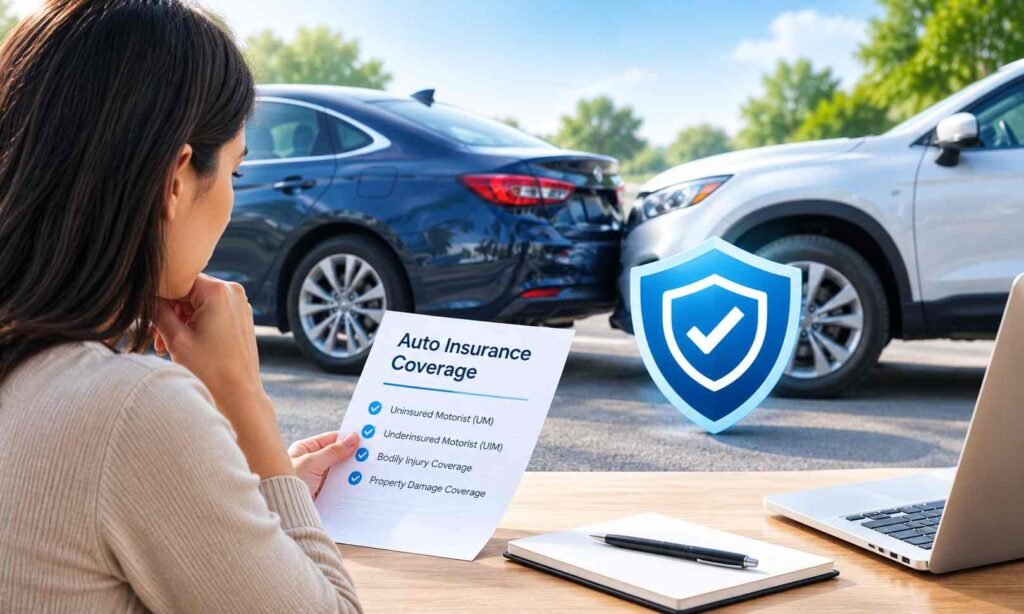
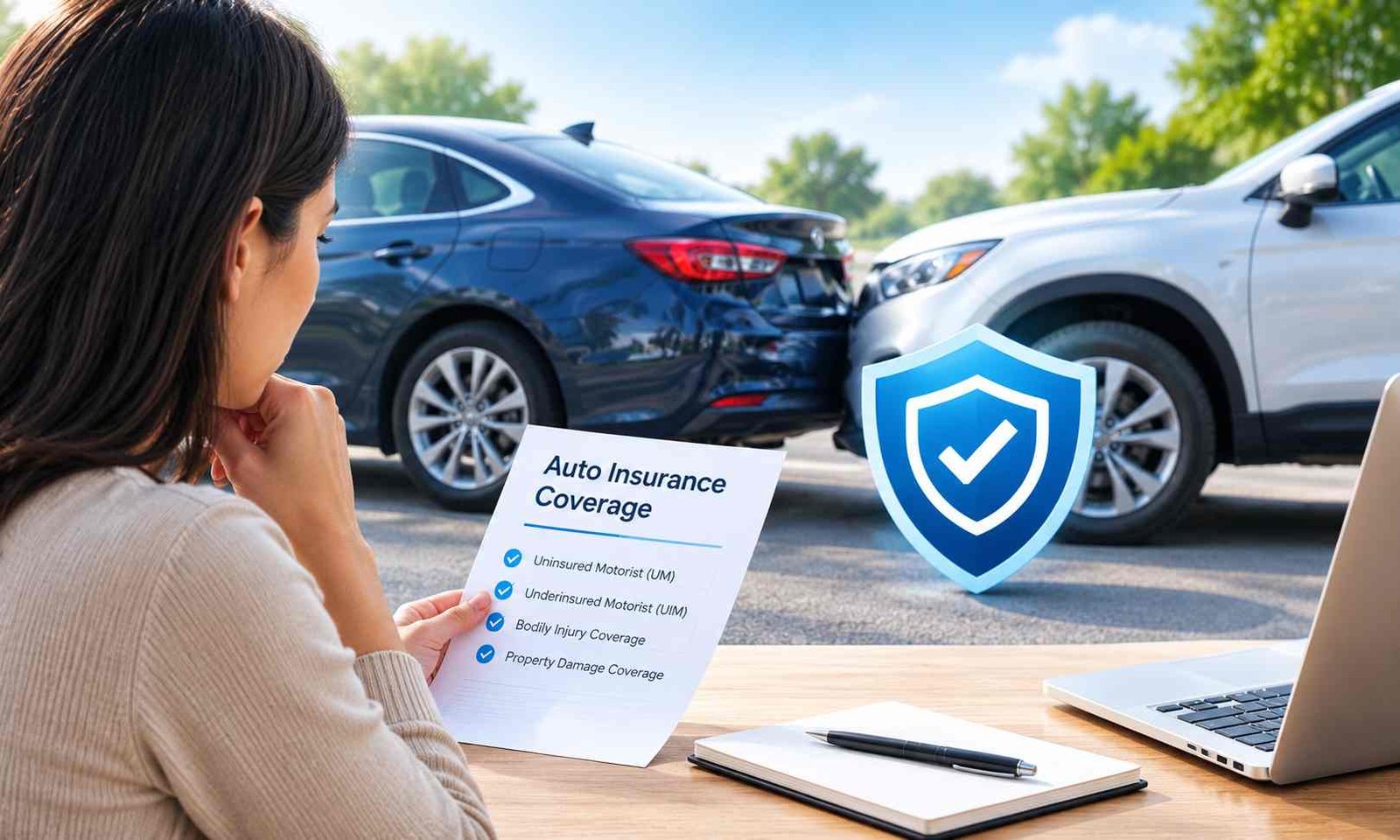
Uninsured and underinsured motorist coverage can help protect you financially when another driver causes an accident but has no auto insurance or does not have enough liability coverage to cover your injuries. Depending on your state and policy, this protection may help pay for medical expenses, lost income, and other covered losses. Separate property damage coverage may also be available.
The right amount of coverage depends on your state’s rules, your existing insurance, your financial circumstances, and how much protection you want if a serious accident occurs.
Before choosing limits, it helps to understand the difference between uninsured and underinsured motorist coverage, what each type pays for, and how it works alongside your other auto insurance.
What Is Uninsured and Underinsured Motorist Coverage?
Uninsured and underinsured motorist coverage is commonly called UM/UIM coverage. It is designed to protect eligible people insured under your policy when an at-fault driver has no insurance or insufficient insurance.
The two types address different situations:
- Uninsured motorist (UM) coverage: May help when the at-fault driver has no qualifying auto liability insurance. Depending on the policy and state law, certain hit-and-run accidents may also qualify.
- Underinsured motorist (UIM) coverage: May help when the at-fault driver has insurance, but the available liability coverage is insufficient to cover your eligible losses.
These coverages do not automatically pay every expense from an accident. The insurer evaluates liability, covered damages, policy limits, exclusions, and applicable state requirements.
The need for this protection is not merely theoretical. The Insurance Research Council estimated that 15.4% of U.S. motorists were uninsured and 18.0% were underinsured in 2023. The figures were reported in 2025 and were based on insurance-claim data rather than a direct count of all drivers.
What Does Uninsured Motorist Coverage Cover?
The answer depends on which UM/UIM coverages you carry and what your state permits or requires. There are two main categories: bodily injury and property damage.
1. Uninsured Motorist Bodily Injury (UMBI)
Uninsured motorist bodily injury coverage may pay for eligible injuries when an uninsured driver causes an accident.
Depending on applicable law and policy terms, covered losses may include:
- Medical treatment and hospital bills
- Rehabilitation and follow-up care
- Lost wages resulting from the injury
- Pain and suffering or other legally recoverable damages
- Injuries to eligible passengers in your vehicle
A claim is subject to the coverage limit and the insurer’s evaluation of liability and damages. Not every expense or claimed amount is automatically covered.
2. Underinsured Motorist Bodily Injury (UIMBI)
Underinsured motorist bodily injury coverage addresses situations where the responsible driver’s liability insurance is insufficient.
For example, imagine another driver causes an accident that results in substantial injuries. Their bodily injury liability limit may cover only part of your eligible damages. Depending on your state’s UIM rules and the terms of your policy, your own UIM coverage may provide additional compensation.
The amount payable is not necessarily the difference between your total bills and the other driver’s insurance payment. Coverage definitions, offsets, settlement rules, liability findings, and policy limits can affect the result.
3. Uninsured Motorist Property Damage (UMPD)
Uninsured motorist property damage coverage may help pay for vehicle damage caused by an uninsured driver. Depending on state law and the policy, the coverage may also apply to certain other property damage.
UMPD is not available on identical terms in every state. There may be a deductible, coverage limit, or special condition for a hit-and-run claim.
4. Underinsured Motorist Property Damage (UIMPD)
Underinsured motorist property damage coverage may help with eligible vehicle or property losses when the at-fault driver’s available property damage liability coverage is insufficient.
Its availability and operation vary. Some drivers rely on collision coverage for vehicle repairs instead, so review the options offered in your state rather than assuming UIM property damage is included.
Uninsured vs. Underinsured Motorist Coverage
The main difference is whether the at-fault driver has qualifying insurance.
| Coverage | Situation | Potential protection |
| Uninsured motorist bodily injury (UMBI) | The at-fault driver has no qualifying liability coverage | Eligible injury-related damages, subject to the policy |
| Underinsured motorist bodily injury (UIMBI) | The driver has insurance, but the available limits are insufficient | Additional compensation where the state’s UIM rules and policy permit |
| Uninsured motorist property damage (UMPD) | An uninsured driver damages your vehicle or eligible property | Covered property damage, subject to availability and policy conditions |
| Underinsured motorist property damage (UIMPD) | The insured at-fault driver’s property damage liability coverage is insufficient | Eligible property losses where this protection is available |
UM/UIM coverage is different from liability insurance. Your own liability coverage generally pays for covered bodily injury or property damage claims made against you when you are responsible for an accident. UM/UIM coverage is intended to protect eligible insured people in certain accidents caused by someone else.
How Much Uninsured and Underinsured Motorist Coverage Do You Need?
There is no single limit that is right for every driver. A useful starting point is to review your bodily injury liability limits, assess your potential financial exposure, and determine what UM/UIM limits your state and insurer allow.
Here are five factors to consider.
1. Review your bodily injury liability limits
Some drivers use their bodily injury liability limits as a starting point when considering UM/UIM bodily injury coverage. In some states, the available UM/UIM limits are tied to the liability limits on the policy.
For example, if your policy has bodily injury liability limits of $100,000 per person and $300,000 per accident, ask your insurer whether matching UM/UIM limits are available and how the limits operate under your state’s rules.
This is a comparison point, not a universal recommendation. Your state may impose different rules or limits.
2. Understand per-person and per-accident limits
A policy may show two bodily injury limits, such as $50,000 per person and $100,000 per accident.
- Per-person limit: The maximum available for one eligible injured person under the applicable coverage.
- Per-accident limit: The maximum available for all eligible injuries arising from one covered accident, subject to the policy’s terms.
Suppose two people insured under a policy are injured in a covered accident. Even if each person’s eligible losses are substantial, the insurer must apply both the relevant individual limit and the overall accident limit.
The limits do not guarantee payment of the stated amount. Liability, eligible damages, policy conditions, and other applicable rules still matter.
3. Consider your financial exposure
Think about what a serious injury could mean for your household. Relevant factors may include your income, the financial resources you rely on, your dependents, and the potential cost of a long recovery.
Health insurance can help with eligible medical care, but it does not necessarily replace lost income or compensate for every legally recoverable injury-related loss. UM/UIM bodily injury coverage may address some losses that other forms of coverage do not, subject to the policy and state law.
4. Account for passengers and other eligible insured people
If family members regularly travel with you, consider who may qualify for protection under your policy. Some policies may extend UM/UIM protection to passengers or certain resident relatives, but eligibility depends on the contract, circumstances, and state requirements.
Do not assume that every household member or passenger is covered in every situation.
5. Review your protection for vehicle damage
If your concern is the cost of repairing or replacing your car, examine your collision coverage, its deductible, and any available UMPD or UIMPD option.
For a newer or more valuable vehicle, the cost of repairs could be significant. For an older vehicle, compare the available coverage, deductible, and realistic value of the car before deciding which protection makes financial sense.
Practical next step: Find the declarations page of your auto policy. Check the UM/UIM coverage types, limits, deductibles, and listed vehicles. If anything is unclear, ask your insurer to explain the available options and any state-specific restrictions in writing.
Is Uninsured Motorist Coverage Worth It?
UM/UIM coverage may be valuable if you want protection against injury-related losses caused by an uninsured or inadequately insured driver. Whether it makes sense for you depends on its cost, availability, your existing protection, and your ability to manage potential uncovered expenses.
It is especially worth examining when:
- You want protection beyond what the other driver’s liability coverage may provide.
- You regularly carry passengers.
- You have concerns about substantial medical expenses or lost income after a serious accident.
- Your health insurance has significant deductibles or does not address every financial consequence of an injury.
- You want to understand your options for a qualifying hit-and-run accident.
There are trade-offs. UM/UIM coverage adds to your insurance premium, has defined limits, and may overlap with some benefits from other policies. It also does not eliminate the need for liability, collision, or other appropriate auto insurance.
Review the coverage rather than deciding based only on whether it is legally required. A legal minimum and a limit that fits your financial circumstances are not necessarily the same.
Uninsured Motorist Coverage Requirements by State
UM/UIM requirements vary across the United States. Depending on the jurisdiction, a state may require certain types of coverage, require insurers to offer specific options, or allow drivers to choose whether to purchase available protection.
The rules may distinguish between bodily injury and property damage coverage. They may also address the limits offered, whether coverage can be rejected, stacking, and the conditions required for a hit-and-run claim.
For that reason, a general nationwide article cannot reliably provide one rule for every driver.
To verify your situation:
- Consult your state’s insurance department website.
- Check the required and optional coverage types for your state.
- Review your current policy and declarations page.
- Ask your insurer whether you have rejected any optional UM/UIM protection and whether you can change your limits.
The National Association of Insurance Commissioners’ uninsured motorists overview provides background on the issue. For a decision about your own policy, use the current guidance from your state insurance department and the actual policy contract.
Uninsured Motorist Property Damage vs. Collision Coverage
UMPD and collision coverage may both help pay for damage to your vehicle after a crash involving an uninsured driver. Their rules and scope are not identical.
| Feature | Uninsured Motorist Property Damage | Collision Coverage |
| Main purpose | Covers eligible property damage caused by an uninsured motorist | Covers eligible damage to your vehicle from a covered collision |
| Fault requirements | Generally tied to an uninsured driver’s responsibility and applicable UM rules | Can apply regardless of who caused the collision, subject to policy terms |
| Availability | Varies by state and insurer | Generally offered as an optional coverage |
| Deductible | May have a separate deductible or other conditions | Usually subject to the collision deductible in your policy |
| Hit-and-run damage | May be restricted or excluded under applicable rules | May be covered if the collision terms are met |
If you carry collision coverage, it may help pay for vehicle repairs after an accident with an uninsured driver. You will generally need to account for your collision deductible. UMPD may have a different deductible and eligibility requirements.
Also remember that UMBI does not automatically pay for damage to your car. Bodily injury and property damage are distinct coverage categories. Check the exact protection shown on your policy.
For a broader explanation of coverage combinations, see our guide to Full coverage car insurance. The phrase “full coverage” is informal and does not guarantee that every possible loss is insured.
Does Uninsured Motorist Coverage Cover a Hit-and-Run?
It may. Uninsured motorist bodily injury coverage can apply to some hit-and-run accidents, depending on state law and policy wording. Property damage from a hit-and-run may be treated differently.
Some jurisdictions or policies impose special reporting, evidence, or physical-contact requirements. You should not assume that every accident involving a driver who leaves the scene qualifies for UM or UMPD benefits.
If you are involved in a hit-and-run:
- Contact emergency services when necessary and report the accident to the police as required.
- Record any available description of the vehicle, license plate details, direction of travel, and other relevant information.
- Preserve photographs, witness contact information, medical records, and repair estimates.
- Notify your insurer promptly and ask which coverages may apply.
- Keep copies of reports, receipts, claim numbers, and communications.
Do not delay reporting while trying to locate the other driver yourself. Early notice can help your insurer explain the evidence and documentation required by your policy.
What Happens If You Get Hit by an Uninsured Driver?
If another driver causes an accident and has no qualifying insurance, your options depend on your coverage, the circumstances, and state law.
Step 1: Protect people and document the incident. Seek medical attention when needed. Record the accident details, collect witness information, take photographs when safe, and obtain the police report information.
Step 2: Notify your insurer. Explain that the other driver may be uninsured. Ask whether UMBI, UMPD, collision, MedPay, PIP, or another part of your policy may apply.
Step 3: Keep evidence of your losses. Save medical bills, records of missed work, repair estimates, receipts, correspondence, and other supporting documents.
Step 4: Review the claim process and deadlines. Check the notice requirements in your policy and ask the insurer about applicable time limits. State laws and contractual deadlines can differ.
Step 5: Review any settlement carefully. Before accepting a settlement from the at-fault driver’s insurer, signing a release, or making an agreement that could affect another claim, check your policy and obtain any required consent from your own insurer. A consent-to-settle clause may affect UIM rights.
If your insurer disputes the claim or denies coverage, request the decision and its reasons in writing. Compare the explanation with the policy wording and relevant state rules. Our guide to What to do when a car insurance claim is denied explains how to review a denial and identify possible next steps.
If a claim is taking longer than expected, keep a record of communications and ask the insurer what information remains outstanding. Our guide to Auto insurance claim delays covers general steps for following up on a delayed claim.
Stacked vs. Unstacked Uninsured Motorist Coverage
Stacking can allow eligible UM/UIM limits from multiple vehicles or policies to be combined, depending on state law and the policy. Unstacked coverage generally means that limits are not combined in that way.
The rules vary. Stacking may be prohibited, restricted, or available only under specific conditions. When offered, stacked coverage may cost more.
Before choosing between stacked and unstacked coverage, ask:
- Is stacking legal and available for my policy in this state?
- Which vehicles or policies can be combined?
- How would the limit change under my actual contract?
- What is the premium difference?
- Are there restrictions that would affect my household?
Compare the actual terms and costs rather than assuming that stacking is always available or always the better option.
How Much Does Uninsured Motorist Coverage Cost?
There is no single national UM/UIM price that applies to every driver. Your premium depends on the coverage selected, the insurer’s pricing, your location, and other rating factors.
The cost may also vary according to whether you select bodily injury coverage, property damage coverage, stacked limits, or additional protection where available.
To compare costs fairly:
- Request prices using the same coverage types and limits.
- Check whether quotes use the same deductibles and stacking options.
- Compare the additional premium with the protection offered.
- Review state-specific coverage requirements and insurer options.
- Revisit your limits when your financial circumstances or policy needs change.
A lower premium does not necessarily represent better value if it comes with substantially lower limits or less protection. Likewise, a higher limit is not automatically the right choice for every household. Review the trade-offs and select coverage within your budget.
Does Filing a UM/UIM Claim Affect Your Insurance Premium?
It depends on the circumstances, your insurer’s rating practices, and applicable state law. Do not assume that a claim will always increase your premium—or that it can never affect your renewal.
If you are concerned about the potential impact, ask your insurer how a not-at-fault UM/UIM claim is treated in your state. You can also consult your state insurance department for consumer guidance about rate increases and claims.
The decision to report an accident should not be based only on a guess about future premiums. Follow the policy’s reporting requirements and obtain accurate information about the coverages that may apply.
Does Uninsured Motorist Coverage Protect Pedestrians?
It may protect an eligible insured person who is struck by an uninsured driver while walking, but coverage is not automatic in every situation.
Eligibility can depend on the policy’s definition of an insured person, the circumstances of the accident, the vehicle involved, and applicable law. A resident relative or another person may be treated differently from an unrelated pedestrian.
If you are hit while walking, report the accident, seek medical care if needed, preserve evidence, and ask your insurer to identify any applicable UM coverage. Do not rely on the assumption that pedestrian protection is included in every policy.
What to Remember About UM/UIM Coverage
Uninsured and underinsured motorist coverage can provide an important layer of financial protection when another driver has no insurance or insufficient coverage. The protection you receive depends on the coverage types you carry, your policy limits, and the laws where the accident occurs.
Before renewing your auto policy, review your declarations page, compare the available UM/UIM limits with your existing bodily injury liability coverage, and understand whether property damage protection is included. Confirm any state-specific questions with your state insurance department or insurer.
Smart Insurance Reviews provides independent insurance education to help consumers understand policy terms and compare coverage options. Learn more about our approach on the About Us page.
Disclaimer: This article is for general educational purposes only. It is not legal advice, an individualized insurance recommendation, or a guarantee of coverage. Insurance rules, policy definitions, limits, exclusions, and claim deadlines vary by state and insurer. Review your actual policy and consult your state insurance department, insurer, or a qualified professional about your circumstances.
Frequently Asked Questions
Do I need UM/UIM coverage if I already have health insurance?
Health insurance may help pay eligible medical expenses, but it may not cover every financial consequence of a serious accident. Depending on the policy, UM/UIM bodily injury coverage may help with eligible lost wages or other legally recoverable damages. Compare the actual benefits, exclusions, deductibles, and limits before deciding whether your existing protection is sufficient.
Does uninsured motorist coverage pay for car damage?
Not necessarily. Uninsured motorist bodily injury coverage addresses eligible injury-related losses. Vehicle damage generally requires available property damage protection such as UMPD or another applicable coverage, including collision. State rules and policy terms determine which options apply.
Can I use UM/UIM coverage if the other driver’s insurance company denies the claim?
Possibly, but a denied claim does not automatically mean the other driver is legally or contractually uninsured. The reason for the denial, the other policy’s status, the definition of an uninsured motor vehicle, and your own policy’s terms all matter. Ask your insurer to explain whether the facts meet the applicable UM/UIM definition.
Can I choose higher UM/UIM limits than my liability limits?
That depends on your state and insurer. Some jurisdictions or policies tie UM/UIM limits to bodily injury liability limits, while the available choices differ elsewhere. Ask which limits are available and whether any legal restriction or policy condition applies.
What should I check before accepting a settlement from the at-fault driver’s insurer?
Check whether accepting the settlement or signing a release could affect your own UIM claim. Review your policy for consent-to-settle or notice requirements and obtain any required written approval before agreeing to the settlement. When the amount is substantial or the terms are unclear, consider getting advice from a qualified attorney in your state.