
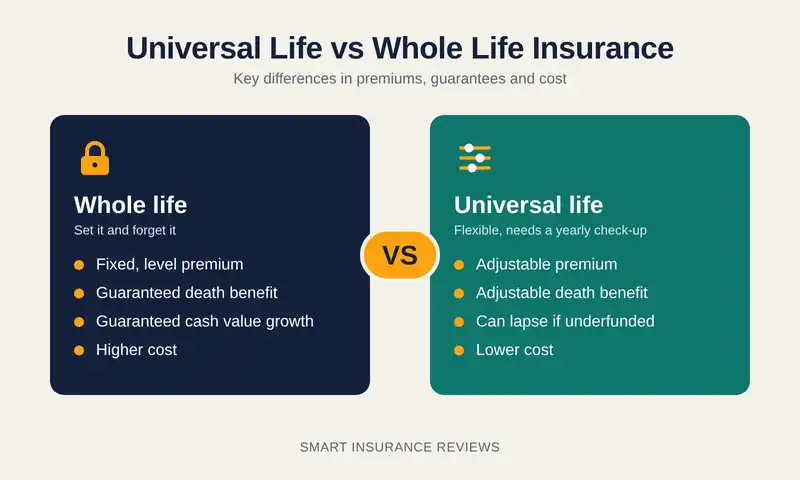
Whole life and universal life look alike on paper. Both last a lifetime, both pay a death benefit, and both build cash value you can borrow against. Once you own one, they behave very differently. Whole life locks in a price and a promise. Universal life hands you a dial and expects you to watch it.
Buyers are choosing both in large numbers. Permanent policies (whole life plus the universal life family) made up about 83% of new U.S. individual life insurance premium in 2025, and whole life alone accounted for 37%, according to LIMRA’s 2025 sales results.
What is the difference between universal life and whole life insurance?
Whole life charges a fixed premium and guarantees the death benefit and a minimum path for cash value growth, so it costs more and asks little of you. Universal life lets you adjust premiums and the death benefit, usually costs less, and can lapse if the cash value runs short. Whole life is the set-it-and-forget-it policy. Universal life needs a yearly check-up.
What is whole life insurance?
Whole life is permanent coverage with guaranteed level premiums. MetLife describes the premium as fixed for the life of the policy, and Thrivent states that the death benefit and the cash value growth are guaranteed as long as premiums are paid.
Some whole life policies also pay dividends. Those dividends are not guaranteed. They depend on the insurer’s results, including investment returns, claims experience and expenses, and only “participating” policies pay them.
You can borrow against the cash value once enough has built up. Any loan, plus the interest that piles up on it, reduces both the cash surrender value and the death benefit paid to your family.
What is universal life insurance?
Universal life is permanent coverage with a flexible premium. The Maryland Insurance Administration explains the mechanics: you choose a “planned premium,” part of each payment covers the cost of insurance, and the rest goes into a cash value account that earns interest at no less than the minimum rate written into the policy.
The cost of insurance rises as you age. Early premiums often exceed it, which is how cash value builds, but the balance can shrink in later decades if the policy is not funded well.
Universal life comes in three main forms, and LIMRA tracks them separately: fixed, indexed and variable. They differ in how the cash value is credited, so the policy contract matters more than the label.
Universal life vs whole life: side-by-side comparison
| Feature | Whole life | Universal life |
|---|---|---|
| Premium | Fixed and level | Flexible within limits; cash value must cover monthly charges |
| Death benefit | Guaranteed while premiums are paid | Adjustable; lasts only if the policy stays funded |
| Cash value growth | Guaranteed growth | Interest never below the policy’s stated minimum; more depends on the type |
| Dividends | Possible on participating policies, never guaranteed | Generally none |
| Lapse risk | Policy stays in force while premiums are paid | Can lapse if cash value cannot cover monthly charges |
| Typical cost | Higher | Lower |
| Policy loans | Reduce cash value and death benefit | Reduce cash value and death benefit |
How much does each policy cost?
A 40-year-old man pays an average of $574 a month for $500,000 of whole life coverage, compared with $362 for universal life and $59 for a 20-year term policy. Those averages come from MoneyGeek’s September 2026 rate analysis for nonsmokers in average health.
| Example buyer ($500,000, nonsmoker, average health) | 20-year term | Universal life | Whole life |
|---|---|---|---|
| Woman, age 25 | Not published | $182 | $349 |
| Woman, age 40 | $47 | $310 | $540 |
| Man, age 40 | $59 | $362 | $574 |
| Man, age 60 | Not published | $930 | $1,443 |
Monthly premiums, average of quotes as published by MoneyGeek (updated August and September 2026). Your price depends on your health, the insurer, the policy type and the guarantees you choose.
The gap is real but it moves with age. In the table, whole life costs $167 more a month than universal life for the 25-year-old woman and $513 more for the 60-year-old man.
The price difference reflects what you get. Whole life pays for guarantees. Universal life charges less because the insurer can pass more of the risk to you.
What are Americans actually buying?
Whole life leads. LIMRA’s full-year 2025 numbers show how new U.S. individual life premium split by product:
| Product | 2025 new premium | Share of total |
|---|---|---|
| Whole life | $6.4 billion | 37% |
| Indexed universal life | $4.5 billion | 25% |
| Term life | $3.1 billion | 17% |
| Variable universal life | $2.6 billion | 15% |
| Fixed universal life | $984 million | 6% |
Total new premium topped $17.5 billion, a record, up 10% from 2024. The trend continued into 2026. In the second quarter, LIMRA reported whole life premium of $1.78 billion, up 9%, while indexed universal life fell 11% to almost $1.1 billion. LIMRA changed its measure in 2026, so compare first-quarter and later 2026 results with earlier years carefully.
Shares reflect premium dollars, not the number of people. Permanent policies carry higher premiums than term, so they take a bigger slice of the money even when term policies are common.
Coverage gaps remain wide. The 2026 Insurance Barometer from LIMRA and Life Happens found that 52% of American adults have some life insurance, 47% of owners get their coverage through work, and 38% of adults (about 92 million people) say they need coverage or more of it.
The risk that catches universal life owners off guard
Universal life fails quietly. A policy built on level payments assumes certain interest rates and insurance costs. If either turns out worse than assumed, the cash value can run out years before you expect.
The Wisconsin Office of the Commissioner of Insurance warned consumers that insurers can raise the cost of insurance, though never above the maximum guaranteed in the policy, and that an underfunded plan meant to last to age 100 might only last to age 80. Many policyholders found their coverage had lapsed with little or no value, or faced large payments to keep it.
Maryland regulators give the same warning: if cash value cannot cover the monthly charge, you may need to raise the premium or lower the death benefit, or the policy ends.
Not all universal life behaves the same. The Society of Actuaries studied 2015 to 2021 lapse experience from 14 insurers, covering about 11.9 million policies and roughly half of flexible-premium universal life sold in that period. It found that lifetime-guarantee policies lapse at materially lower rates than other universal life designs after the third policy year (SOA, 2015-2021 Universal Life Lapse Study).
Two habits protect you:
- Read the annual statement. Insurers send one each year, and Wisconsin regulators say it should warn you if cash value won’t carry the policy to the next report.
- Ask for an in-force illustration. Wisconsin regulators say you can request one each year at no cost. Then ask what premium keeps coverage active to your target age under current conditions.
Loans, taxes and the one rule to know
Life insurance death benefits are generally excluded from the beneficiary’s gross income under 26 U.S.C. § 101(a)(1). There are exceptions. One is the transfer-for-value rule, which limits the exclusion if a policy is sold or traded for money.
Policy loans are generally not taxable when you receive them, MetLife notes. The tax bill can arrive later. If the policy is surrendered or lapses with a loan outstanding, any amount of the loan plus interest above your cost basis may become taxable.
Funding a policy too fast has its own consequence. Under 26 U.S.C. § 7702A, a policy that fails the “7-pay test” becomes a modified endowment contract (MEC), which changes how money you take out is taxed. A tax professional can tell you how that applies to a specific policy.
Who each policy tends to fit
Whole life tends to fit people who:
- Want a fixed premium and a guaranteed benefit they never have to monitor.
- Plan to hold the policy for life, for estate or final expense needs.
- Are comfortable paying more for certainty.
Universal life tends to fit people who:
- Want lifetime coverage at a lower starting premium than whole life.
- Need room to raise or lower payments as income changes.
- Will review the annual statement and an in-force illustration every year.
Term life may fit better if you only need coverage while the mortgage or the kids’ needs last. At the example prices above, a 40-year-old man pays $59 a month for 20-year term coverage, against $574 for whole life. Read how a larger term policy works in our guide to $500,000 term life insurance, compare carriers in best life insurance providers, or see options for life insurance for seniors over 60.
Frequently asked questions
Which policy builds cash value more predictably?
Whole life, because the growth is guaranteed. Universal life earns at least the policy’s minimum rate, but how much more you get depends on the policy type and how much you pay beyond the cost of insurance.
Can a whole life policy lapse?
It stays in force while premiums are paid. Loans are the exception: if loans plus unpaid interest grow larger than the policy’s guaranteed cash value and other eligible values, MetLife says the policy can be cancelled, which counts as a surrender and may create a taxable gain.
Can universal life premiums go up?
The premium you need can rise. Insurers can raise the cost of insurance, though not above the guaranteed maximum in your contract, and a shortfall means paying more or accepting a lower death benefit.
Are whole life dividends guaranteed?
No. Dividends are not guaranteed, and only participating policies pay them.
Is a life insurance payout taxable?
A death benefit paid because the insured died is generally excluded from gross income under federal law, subject to exceptions such as transfer-for-value.
Is term life a better deal than either?
It costs far less for a set period, but it ends when the term does and builds no cash value. The right choice depends on how long you need coverage.
This content is general education and does not replace advice from a licensed insurance agent or your state insurance department. Rates, features and tax treatment vary by insurer, policy and state.