
Finding the best car insurance for young drivers is less about identifying one company and more about finding the right combination of price, coverage, discounts, eligibility, and policy structure for the driver.
That matters because current 2026 insurance research does not produce one universal cheapest insurer. Different studies use different ages, vehicles, coverage limits, locations, credit profiles, and family arrangements. For example, ValuePenguin’s September 2026 research reports substantially different results depending on whether the young driver has a standalone policy or is added to a parent’s policy, while NerdWallet’s September 2026 analysis shows different large-carrier rates for 20-year-old drivers.
Young drivers also face a genuine pricing challenge. The CDC says drivers ages 16–19 have a fatal crash rate almost three times that of drivers ages 20 and older per mile driven, while IIHS reports that crash risk is particularly high during the first months after licensure.
The goal, therefore, is not simply to find the lowest advertised premium. It is to compare like-for-like coverage, understand the discounts a young driver may actually qualify for, and choose a policy that fits the driver’s age, vehicle, household and state.
Key takeaway: There is no single car insurance company that is cheapest for every young driver. The strongest comparison starts with the same coverage limits and deductibles across multiple insurers, then evaluates price, discounts, policy features, availability and customer-facing performance.
How Much Is Car Insurance for Young Drivers in 2026?
Young-driver insurance can be significantly more expensive than insurance for experienced adults, particularly when a teenager buys a standalone policy.
Current published figures illustrate how much methodology matters.
| Driver profile | Current published example | Source |
| 18-year-old, standalone full coverage | $599/month | ValuePenguin, September 2026 |
| 20-year-old, Progressive full coverage | 3,598/year(300/month) | NerdWallet, September 2026 |
| 20-year-old, Travelers full coverage | 3,648/year(304/month) | NerdWallet, September 2026 |
| 20-year-old, GEICO full coverage | 3,777/year(315/month) | NerdWallet, September 2026 |
| 20-year-old, State Farm full coverage | 4,400/year(367/month) | NerdWallet, September 2026 |
| 20-year-old, USAA full coverage | 3,439/year(287/month) | NerdWallet, September 2026 |
The ValuePenguin 18-year-old study uses a 50-state sample, a single 18-year-old driver profile, a 2018 Honda Civic, good credit and specified higher liability limits. NerdWallet’s figures are median rates for 20-year-old drivers. These are research benchmarks, not personalized quotes.
There is another important example of why you should not copy a single national average into your budget. ValuePenguin’s separate teen comparison page reports an average of about $410 per month for an 18-year-old under a different methodology using quotes from Illinois, Pennsylvania and Georgia. It also says that adding a teen to a parent’s policy is substantially less expensive in its sample.
That difference does not necessarily mean one source is wrong. It means age, location, vehicle, coverage, driver profile and methodology materially affect insurance prices.
Why Is Car Insurance So Expensive for Young Drivers?
Insurance companies use underwriting and rating factors to estimate the risk of future claims. Age and driving experience are important, but they are not the only variables.
The NAIC explains that insurance pricing involves both underwriting and rating, with insurers assessing the risk associated with an applicant and then assigning a price based on the expected financial responsibility of potential claims.
For a young driver, insurers may also consider:
- State and ZIP code
- Driving history
- Vehicle make, model and value
- Annual mileage
- Selected liability limits
- Collision and comprehensive coverage
- Deductibles
- Claims history
- Household drivers
- Credit-based insurance information where permitted by state law
- Available discounts
- Whether the young driver is on a family or standalone policy
The safety issue behind higher teen rates is also well documented. IIHS reports that the fatal crash rate per mile for drivers ages 16–19 is about three times the rate for drivers 20 and older, with the highest risk occurring at ages 16–17.
That risk generally improves as young drivers accumulate experience and maintain clean driving records, but there is no single birthday at which rates automatically become inexpensive.
Car Insurance Rates by Age: 16 Through 25
Young-driver insurance should not be treated as one pricing category.
A 16-year-old newly licensed driver and a 24-year-old with several years of clean driving history can have dramatically different rates.
The typical pattern is:
Age 16–17: Highest-risk period and generally the most expensive period for new drivers.
Age 18–19: Rates can begin declining as driving experience increases, although premiums can remain high.
Age 20–21: The difference becomes more noticeable for many drivers, particularly when they have a clean record.
Age 22–24: Continued experience can help lower premiums, although vehicle, location and other rating factors still matter.
Around 25: Many drivers see another meaningful age-related reduction, but insurers do not simply apply one nationwide rate at age 25.
Current 2026 research supports this broader pattern. NerdWallet’s September 2026 analysis, for example, reports substantially lower sample rates for 20-year-old drivers than many teen-driver studies.
The key point is that age is a pricing factor, not a guarantee of a particular premium.
Best Car Insurance Companies to Compare for Young Drivers in 2026
Current 2026 comparison studies disagree on which insurer produces the lowest price. That is expected because each publisher uses different methodologies.
LendingTree’s January 2026 analysis highlighted regional companies such as Erie and Country Financial for teen rates while identifying State Farm among large national companies. ValuePenguin’s September 2026 analysis identifies different results depending on whether the teen has an individual policy or joins a family plan. NerdWallet’s September 2026 analysis identifies Progressive with the lowest listed large-carrier median rate for its 20-year-old full-coverage sample, while USAA’s sample is lower but has restricted eligibility.
That is why it is more useful to understand what each insurer offers young drivers than to publish one permanent winner.
State Farm
State Farm currently advertises several programs relevant to teenage and young drivers, including a good-student discount of up to 25%, a driver-training discount and a student-away-at-school discount. It also offers teen-focused safe-driving programs. Availability and eligibility can vary by state.
State Farm is therefore worth including in comparisons when a household has a student, a newly licensed teen or a driver who can qualify for driver-training or safe-driving programs.
GEICO
GEICO currently advertises a good-student discount of up to 15% on certain coverages, a student-away-at-school discount and its DriveEasy usage-based program. The company says discount availability varies by state and eligibility.
GEICO can be particularly relevant when the household wants to compare a national insurer that offers both traditional student discounts and a telematics-based option.
Progressive
Progressive currently advertises a teen-driver discount for drivers age 18 or younger and a good-student discount of about 5% in most states. Its Snapshot program uses driving information to determine potential savings.
NerdWallet’s September 2026 sample also places Progressive at $3,598 annually for a 20-year-old’s full-coverage policy, although that figure applies to its specific methodology and should not be treated as a universal quote.
Travelers
Travelers appear frequently in current young-driver comparisons. CNBC Select’s September 2026 analysis identifies Travelers for affordability and notes discounts involving good students, approved driver’s education and students who leave a vehicle at home while attending college. Its methodology uses a specific family/teen profile, so those sample rates should not be treated as personalized pricing.
Travelers can be worth comparing when discounts and additional policy features are important alongside price.
Auto-Owners
Auto-Owners is another carrier that appears prominently in current teen-driver research. Its current discount information includes a good-student discount of up to 20%, student-away-at-school savings and teen-driver monitoring options. It sells through independent agents rather than directly to consumers.
ValuePenguin’s September 2026 comparison identifies Auto-Owners as its lowest-cost option for adding a teen to a policy under its particular methodology. That is useful comparison evidence, not a guarantee for every household.
Erie
Erie is particularly relevant for families in the states where it operates. Its current teenSMART program is available to qualifying customers ages 16 through 20 and may provide up to a 20% auto insurance discount after successful completion, subject to state and policy rules. Erie also advertises young-driver, multi-car, reduced-usage and accident-forgiveness features.
Because Erie is a regional insurer, availability should be checked before using its rate as a national benchmark.
USAA
USAA is another carrier frequently appearing in young-driver rate comparisons, but eligibility is restricted to people who meet its membership requirements.
NerdWallet’s September 2026 analysis reports a $3,439 annual full-coverage median for a 20-year-old in its sample, lower than the other listed companies in that table. Because eligibility is limited, that figure should not be interpreted as an option available to every young driver.
Family Policy vs. Standalone Young Driver Insurance
For many households, the most important financial decision is not which insurer to use but whether the young driver should remain on the family policy.
Adding a teen can increase the household premium substantially. The Insurance Information Institute notes that adding a teenage driver can increase a parent’s premium by 50% or even 100%, although the actual change depends on the insurer and household.
At the same time, purchasing a separate policy can be considerably more expensive for a young driver.
Current ValuePenguin research found that teens and young drivers could save an average of 62% by joining a parent’s policy rather than purchasing their own policy under its methodology.
Staying on a Family Policy Often Makes Sense When:
- The young driver lives at the same permanent address.
- The parent owns or insures the vehicle.
- The young driver regularly drives household vehicles.
- The household can qualify for multiple-driver, multiple-car or other discounts.
- The insurer permits the arrangement under its underwriting rules.
A Standalone Policy May Need to Be Considered When:
- The young driver owns and registers the vehicle independently.
- The young driver permanently moves away from the household.
- The young driver establishes a different insurance address.
- Household risk factors make another policy structure worth quoting.
- The insurer requires a separate policy because of ownership or residency circumstances.
The Washington Office of the Insurance Commissioner says adding a teen to an existing policy is generally less expensive, but also notes exceptions involving vehicle ownership, permanent moves and household circumstances.
Do not remove a young driver from a policy simply because they turn 18, 21 or 25. The correct point to reconsider the arrangement depends on where they live, whose vehicle they drive, who owns the car and the insurer’s rules.
How to Add a Teen Driver to a Car Insurance Policy
Start the conversation with the insurer before the young driver begins driving regularly.
The NAIC advises consumers to disclose household drivers and stresses the importance of comparing quotes with matching coverage limits and deductibles.
A practical process is:
- Ask your insurer what it requires. Requirements can differ when the teen has a learner’s permit versus a full license.
- Request the premium before and after adding the driver.
- Ask for every applicable young-driver discount.
- Confirm which vehicle the young driver will operate most often.
- Request competing quotes using the same coverage limits and deductibles.
- Review the final policy documents rather than relying only on the quote summary.
You should also disclose where the vehicle is normally kept. A different garaging address can change the rating and policy requirements.
Does a Learner’s Permit Need Car Insurance?
A learner’s permit does not automatically mean the teenager needs a separate standalone insurance policy.
In many situations, a permitted driver is covered under a parent’s or guardian’s policy, but when the teen must be formally added can vary by insurer and state. Experian’s current August 2026 guidance specifically recommends checking with the insurer because some companies cover a permitted teen under the existing policy until licensing while others may require a change earlier.
The safest approach is to contact the insurer before the teen starts driving with the permit and document the answer.
Do not assume that another family’s experience in a different state applies to your policy.
Young Driver Discounts That Can Lower the Premium
Discounts can make a meaningful difference, but discount percentages should not be added together as though every saving is applied to the original premium independently.
More importantly, eligibility and availability vary by insurer and state.
Good Student Discount
Good-student discounts are among the most common programs for teen and college drivers.
Current examples include:
| Insurer | Current advertised young-driver example |
| State Farm | Good-student discount up to 25% |
| GEICO | Up to 15% on certain coverages |
| Auto-Owners | Good-student discount up to 20% |
| Progressive | About 5% in most states |
| Erie | teenSMART may provide up to 20% for qualifying ages 16–20 |
These numbers are not directly comparable because each insurer has its own eligibility requirements, rating structure and applicable coverages.
Ask about:
- Minimum GPA
- Class standing requirements
- Eligible schools
- Report-card or transcript documentation
- Homeschool requirements
- Renewal documentation
- Maximum eligible age
State Farm, for example, currently publishes requirements for good-student, driver-training and student-away programs, but says discount availability varies by state.
Driver Education Discount
A certified driver’s education or training course may qualify a young driver for an insurance discount depending on the carrier and state.
State Farm currently advertises a driver-training discount for qualifying young operators, while Travelers also identifies approved driver’s education as one way families may save.
Do not pay for a course solely because somebody promises an insurance discount. First confirm that the insurer accepts the course.
Student-Away-at-School Discount
A college student who lives away from home and leaves the vehicle behind may qualify for a reduced rate or other policy adjustment.
State Farm, GEICO, Erie and other insurers currently advertise programs for qualifying students who attend school away from home. Requirements can include age, distance from home, vehicle access and how often the student drives.
Telematics and Usage-Based Insurance
Usage-based insurance uses driving information to help determine pricing.
Depending on the program, the insurer may monitor factors such as mileage, braking, acceleration, time of driving or other driving behaviors. Experian’s 2026 explanation notes that young drivers and low-mileage drivers may benefit from usage-based insurance, but also warns that some driving behaviors can result in higher premiums under certain programs.
Before enrolling, read the program’s terms carefully and determine:
What is monitored?
How long is the monitoring period?
What data is collected?
Can participation affect renewal pricing?
Is the program available in your state?
Who in the household has to participate?
Do not assume every telematics program works the same way.
How Vehicle Choice Affects Young Driver Insurance
The vehicle is often overlooked when families focus only on choosing an insurer.
A car with strong safety equipment, lower repair costs and a lower replacement value may cost less to insure than a high-performance or luxury vehicle, but there is no simple rule that says an older vehicle is always the cheapest.
The Washington Office of the Insurance Commissioner recommends getting an insurance quote before buying the vehicle, because the age, make and model can materially affect the premium.
Current ValuePenguin research found the Subaru Outback, Honda CR-V and Mazda CX-5 among the cheaper vehicles to insure for teens in its 2026 study, with the vehicles selected based on factors including safety and price. Those results apply to its particular vehicle and driver profiles rather than every household.
When choosing a car for a young driver, compare:
| Vehicle factor | Why it matters |
| Safety equipment | May affect claim severity and available discounts |
| Vehicle value | Higher replacement value can affect physical-damage coverage costs |
| Repair costs | More expensive repairs can increase claim costs |
| Theft history | Higher theft risk can affect comprehensive pricing |
| Engine/performance | Higher-performance vehicles may have different risk profiles |
| Financing | A lender may require physical-damage coverage |
The cheapest vehicle to buy and the cheapest vehicle to insure are not necessarily the same thing.
Liability vs. Full Coverage for Young Drivers
Before comparing insurers, decide what type of coverage you are comparing.
The NAIC identifies liability, uninsured/underinsured motorist coverage, personal injury protection where applicable, collision and comprehensive coverage as important parts of auto insurance. It also recommends matching coverage limits and deductibles when comparing quotes.
Liability Coverage
Liability insurance generally pays for covered bodily injury and property damage you cause to another party when you are legally responsible.
State minimum limits are not the same across the country.
A quote using only the legal minimum in one state should not be compared directly with a quote containing substantially higher liability limits.
Collision Coverage
Collision coverage generally helps pay for covered damage to the insured vehicle resulting from a collision, subject to the policy’s terms and deductible.
Comprehensive Coverage
Comprehensive coverage generally addresses non-collision losses such as theft, vandalism, certain weather events, fire or animal strikes.
NAIC’s June 2026 consumer guidance explains these coverage categories and notes that lenders commonly require both collision and comprehensive coverage when a vehicle is financed.
For a deeper explanation, read our Full coverage car insurance guide.
What Deductible Should a Young Driver Have?
The deductible is the amount you are generally responsible for paying toward a covered collision or comprehensive claim before the insurer pays the covered remainder.
A higher deductible can reduce the premium, but it also increases the amount you would need to pay after a covered loss. NAIC specifically recommends considering how much you could afford when choosing a deductible.
For a young driver, the important question is not:
“Which deductible gives the lowest premium?”
It is:
“Could the household comfortably pay this deductible after an accident?”
Compare the same deductible across insurers before deciding which quote is cheaper.
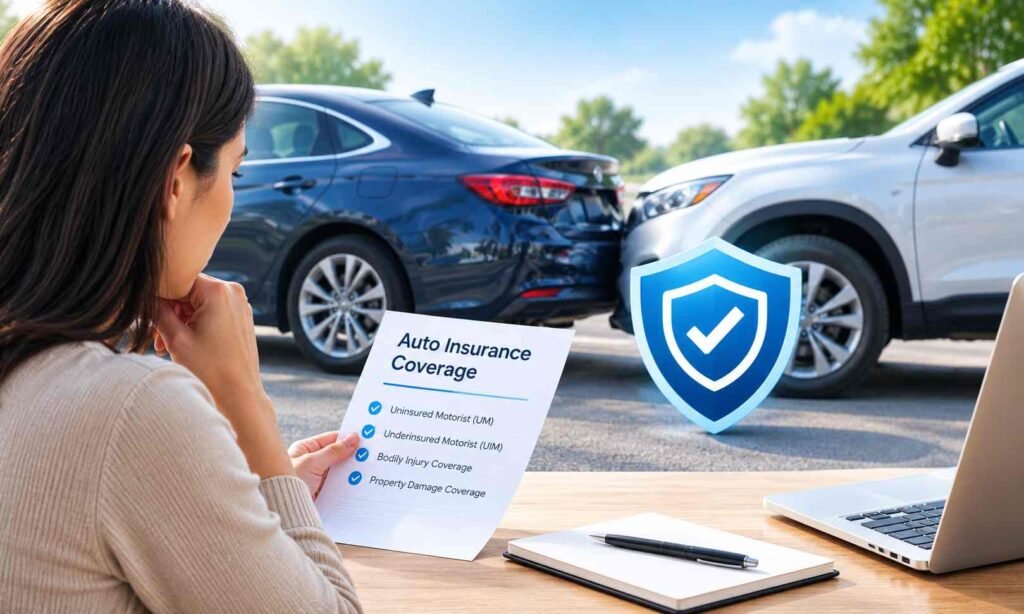
Uninsured and Underinsured Motorist Coverage Matters Too
A young driver can be involved in an accident caused by somebody who has no insurance or not enough insurance.
Uninsured/underinsured motorist coverage may provide protection in those circumstances, depending on the state and policy.
The NAIC notes that UM/UIM coverage is required in some states and available in others, with the exact protection depending on policy terms and applicable state requirements.
When comparing policies, check:
Whether UM/UIM is included or optional
The bodily injury limits
Whether property damage is covered
Your state’s requirements
This is one reason a quote with a lower monthly price can provide less protection.
How to Compare Young Driver Car Insurance Quotes Correctly
This is the part many shoppers skip.
A price comparison is meaningless when the quotes use different coverage.
The NAIC recommends matching important coverage elements when comparing online auto insurance quotes, including liability limits, UM/UIM limits, PIP where applicable, and collision and comprehensive deductibles.
Use this checklist:
1. Use the Same Driver Information
Give every insurer the same:
- Driver age
- Driving history
- Address
- Annual mileage
- Vehicle
- Household drivers
- Student status
2. Use the Same Coverage
Match:
- Liability limits
- UM/UIM limits
- Collision
- Comprehensive
- Deductibles
- PIP or medical payments where applicable
- Important optional coverages
3. Apply Discounts Before Comparing
Ask every insurer about:
- Good student
- Driver training
- Telematics
- Student away at school
- Multi-car
- Bundling
- Safe-driver programs
- Other household-specific discounts
4. Compare the Total Household Premium
For a teen being added to a family policy, ask:
Current family premium: $X
Family premium after adding teen: $Y
Increase: $Y − $X
Then compare the complete household cost with competing insurers.
5. Check Availability and Eligibility
A low regional-carrier rate is not useful if the carrier does not sell policies in your state or the driver does not meet its eligibility rules.
6. Check the Insurer Beyond Price
The NAIC’s Consumer Insurance Search allows consumers to research insurance-company complaints, licenses and financial information. NAIC also cautions against using one metric alone when evaluating an insurer.
How to Choose the Right Policy for a College Student
College changes the insurance calculation.
A student may:
- Live with parents
- Move to a campus in another city
- Take the vehicle to school
- Leave the vehicle at home
- Drive only during school breaks
- Permanently establish a new residence
- Buy or register a vehicle independently
Each scenario can affect the policy.
For a student who moves away but leaves the car at home, ask about a student-away-at-school discount or another appropriate rating adjustment. GEICO, State Farm and Erie all currently advertise programs or savings related to students who attend school away from home.
Do not simply change the student’s address online without asking the insurer how residency and vehicle garaging should be handled.
When Can You Remove a Young Driver From a Policy?
Turning 18 does not automatically mean a driver should be removed.
Likewise, turning 21 or 25 does not automatically mean they must obtain a separate policy.
The more important questions are:
- Does the driver still live in the household?
- Does the driver still use household vehicles?
- Who owns the vehicle?
- Where is the vehicle normally kept?
- Is the driver attending college?
- Has the driver permanently moved out?
- Does the insurer require the driver to remain listed?
Washington’s insurance regulator notes that a permanently moved-out teen may no longer qualify for coverage under the parent’s policy, while other situations can depend on the insurer.
Always confirm the change with the insurer before removing a young driver.
Common Mistakes That Make Young Driver Insurance More Expensive
Choosing an insurer based only on one advertised rate
A published national average is not your quote.
Comparing different coverage levels
A minimum-liability quote can look dramatically cheaper than full coverage because it protects against different risks.
Forgetting student discounts
A young driver may qualify for a good-student, driver-training or student-away-at-school program.
Buying the car before checking insurance
Get the insurance quote before purchasing the vehicle.
Assuming telematics programs are identical
Usage-based insurance programs differ in data collection, eligibility, scoring and pricing effects.
Removing a young driver too early
Household and insurer rules matter more than age alone.
Shopping only one company
Insurance prices vary by insurer because each company evaluates risk differently. Comparing multiple insurers using identical coverage is more informative than assuming one carrier is always cheapest.
A Simple Young Driver Insurance Comparison Worksheet
Before requesting quotes, prepare this information:
| Information | Example to gather |
| Driver | Age, license status, driving history |
| Household | All licensed household drivers |
| Vehicle | Year, make, model, VIN if available |
| Mileage | Estimated annual miles |
| Location | Primary residence and vehicle garaging address |
| Coverage | Liability limits, UM/UIM, collision, comprehensive |
| Deductibles | Same deductible for each quote |
| Student status | Grades, school status, distance from home |
| Programs | Driver training and telematics eligibility |
| Policy structure | Family policy vs. standalone policy |
Then request at least several comparable quotes rather than choosing a company from a generic national ranking.
Final Takeaway
The best car insurance for young drivers in 2026 is the policy that provides the coverage the driver actually needs at a competitive price for that specific household.
Do not rely on a single “cheapest company” list. Current 2026 research produces different results because insurers and publishers use different driver profiles, vehicles, locations, coverage limits and policy structures.
For a better comparison:
Start with the family-vs.-standalone decision.
Use the same coverage and deductibles for every quote.
Ask about good-student, driver-training, student-away and telematics programs.
Check the vehicle’s insurance cost before buying it.
Review the insurer’s availability, complaint information and financial information in addition to price.
And remember that state insurance laws, eligibility rules, discounts, coverage requirements and insurer pricing can change. A licensed insurance professional or your state insurance department can provide guidance specific to your situation.
Smart Insurance Reviews provides general insurance education and comparison information. It is not an insurance carrier or licensed insurance agency and does not sell insurance policies or earn commissions from carrier referrals.
Frequently Asked Questions
Is car insurance cheaper for a young driver on a parent’s policy?
Often, yes. Current consumer and regulator guidance generally indicates that adding a young driver to an existing household policy is usually less expensive than buying a separate policy, although exceptions exist based on vehicle ownership, residency, household risk and insurer rules.
How much does car insurance cost for an 18-year-old in 2026?
It depends heavily on the methodology. ValuePenguin’s current 50-state study reports an average of $599 per month for full coverage for an 18-year-old under its specified driver and vehicle profile. Its separate teen comparison uses a different three-state methodology and reports a lower average. These figures should be treated as research benchmarks rather than personalized rates.
Do good grades really lower car insurance?
They can. Several insurers currently advertise good-student discounts, but requirements and savings differ. State Farm advertises up to 25%, GEICO up to 15% on certain coverages and Auto-Owners up to 20%, subject to eligibility and state-specific rules.
Does a learner’s permit require a separate car insurance policy?
Not necessarily. A permitted teen is often covered through an existing household policy, but the insurer may have specific rules about when the teen needs to be added. Contact the insurer before the teen begins driving.
Should college students stay on their parents’ car insurance?
They may be able to when they remain part of the household’s insurance arrangement, but college attendance can change residency, vehicle use and garaging. Students who leave their cars at home may also qualify for specific savings programs. The insurer should confirm the correct policy structure.
Can a young driver get their own car insurance?
Yes, depending on the driver’s age, vehicle ownership, state and insurer. A standalone policy may become necessary or more appropriate when the young driver owns the vehicle independently or permanently establishes a separate household.
Is telematics insurance worth considering for a young driver?
It can be worth comparing when a young driver has safe, consistent driving habits or relatively low mileage. Usage-based programs vary, however, so review exactly what driving information is collected and how the insurer uses it before enrolling.
What is the cheapest car to insure for a teenager?
There is no single cheapest vehicle for every teenager. In ValuePenguin’s 2026 study, the Subaru Outback, Honda CR-V and Mazda CX-5 were among the lower-cost vehicles to insure for teens under that study’s assumptions. Your state, vehicle configuration, driver profile and coverage will produce different results.