

Insurance premiums drain thousands from your budget annually, but most policyholders overpay without realizing it. Understanding the specific factors that influence your rates empowers you to cut costs significantly. Premium calculation follows a small set of rating factors that carriers must file with state regulators. Knowing which ones carry the most weight is what lets you move your own rate.
Five factors, applied together, can reduce insurance costs by up to 40 percent. You will learn actionable strategies to implement immediately and understand which changes deliver the fastest savings. These tactics work for auto, homeowners, and renters insurance across all major carriers when hunting for cheap insurance quotes.
📖 The Core Reality: There is one trap consumers fall into repeatedly. They chase the absolute lowest premium without looking at the coverage limits. We recently reviewed a case where a driver switched to a cheap carrier and saved 400 dollars a year, but did not realize their new policy dropped their uninsured motorist coverage to the state minimum. When they got rear ended by an uninsured driver, they were left paying 6,000 dollars out of pocket for their own car repairs. Cheap insurance is only a good deal if the coverage limits still protect your assets. Always compare the declarations page, not just the monthly price.
Understanding How Insurance Premiums Work
Insurance companies calculate premiums using sophisticated actuarial models that assess your individual risk profile. Actuaries analyze historical loss data, demographic patterns, and claims frequency to determine the pure premium, the expected cost of covering your claims. Carriers then add loading factors for administrative expenses, commissions, and profit margins.
Your premium reflects dozens of variables specific to your situation. Auto insurers evaluate driving history, vehicle type, annual mileage, garage location, and credit based insurance scores. Homeowners insurers assess property age, construction quality, claims history, protective devices, and geographic risks like hurricanes or wildfires.
The Insurance Information Institute reports that average auto insurance premiums reached 1,895 dollars annually in 2026, though costs vary dramatically by state. Michigan drivers pay 3,150 dollars on average, while Maine residents pay 965 dollars. Homeowners insurance averages 1,820 dollars nationally, ranging from 880 dollars in Hawaii to 4,560 dollars in Florida.
Different carriers weigh risk factors differently based on their unique loss experience. One insurer might penalize young drivers heavily while another focuses more on vehicle type. This variation creates opportunities. The same driver receives quotes varying by 30 to 50 percent between carriers for identical coverage.
Understanding premium mechanics reveals why the following five factors create such dramatic savings potential. Each strategy addresses specific risk elements that actuaries use to price your policy.
| Pros of Hunting for Cheap Insurance Quotes | Cons of Hunting for Cheap Insurance Quotes |
|---|---|
| Significant Budget Relief: Stacking discounts and raising deductibles can free up hundreds of dollars annually for other financial goals. | The Coverage Creep Risk: In the rush to lower premiums, consumers often accidentally drop vital coverages like Uninsured Motorist or Rental Reimbursement. |
| Leverages Competition: Forcing carriers to compete for your business rewards you with retention discounts and new customer incentives. | Time Consuming Process: Truly comparing apples to apples quotes across 5 or more carriers takes 2 to 3 hours of detailed paperwork review. |
| Encourages Financial Health: The process naturally incentivizes improving your credit score and maintaining a clean driving record. | Telematics Privacy Tradeoffs: Getting the deepest discounts often requires installing tracking apps that monitor your exact driving habits. |
| Customizable Risk: Allows you to align your deductibles with your actual emergency savings, rather than accepting default carrier limits. | Potential for Agent Fatigue: Constantly switching carriers every year can sometimes flag you as a high risk hopper in industry databases. |
Factor 1: Credit Score Improvement Can Cut Premiums 20 to 30 Percent
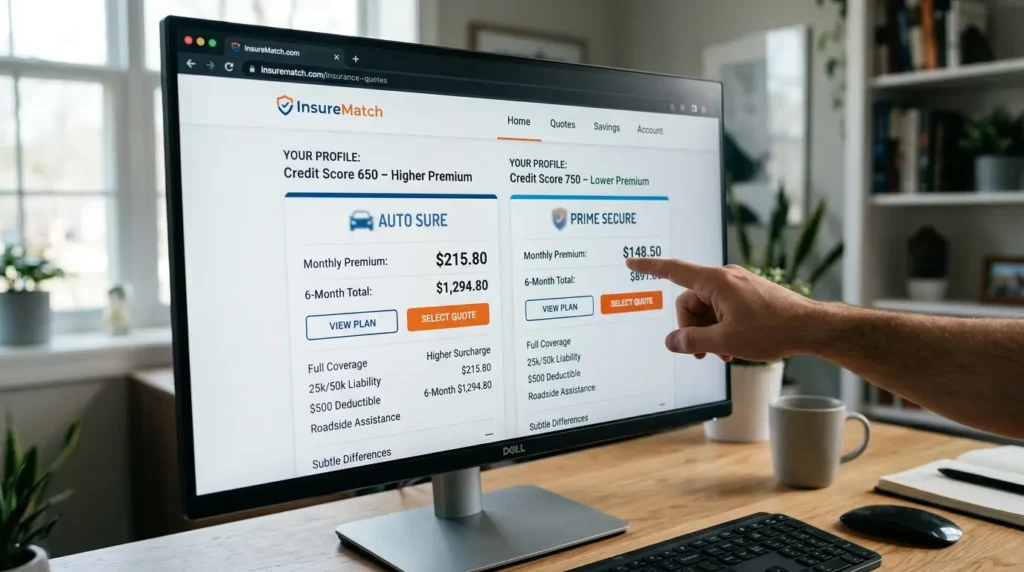
Credit based insurance scores powerfully influence your premium rates. Insurers use statistical models showing a strong correlation between credit management and claim frequency. Policyholders with excellent credit file fewer claims and cost insurers less money over time.
Most states allow insurers to use credit data when calculating premiums. The scoring models differ from traditional credit scores. They emphasize payment consistency, debt levels, credit history length, and new credit inquiries. Insurance specific models predict claim likelihood rather than loan default risk.
Research from the Federal Trade Commission confirms that drivers with poor credit file 40 percent more claims than those with excellent credit. This statistical relationship justifies premium differences that can exceed 1,000 dollars annually for identical coverage.
Consider this real world comparison from March 2026 quotes for a 35 year old driver with a clean record in Chicago seeking full coverage on a Honda Accord:
- Credit score 650 (fair): 2,640 dollars annual premium
- Credit score 750 (excellent): 1,850 dollars annual premium
- Savings: 790 dollars annually (30 percent reduction)
Major carriers weigh credit scores differently. Progressive and Allstate apply significant credit based adjustments, while USAA and Amica focus more on driving history. State Farm positions itself in the middle, balancing multiple risk factors.
Three states prohibit credit based insurance scoring entirely: California, Hawaii, and Massachusetts. Maryland, Oregon, and Utah impose restrictions on how insurers use credit data. If you live in these states, focus on other premium reduction strategies.
Improve your credit based insurance score through these actions:
- Pay all bills on time for at least 12 consecutive months. Payment history represents the largest scoring factor. Set up automatic payments to avoid missed due dates.
- Reduce credit utilization below 30 percent of available limits. High balances signal financial stress. Pay down credit cards strategically, starting with those closest to their limits.
- Dispute credit report errors immediately. Federal law requires credit bureaus to investigate disputes within 30 days. Order free annual reports from all three bureaus at AnnualCreditReport.com.
- Avoid opening new credit accounts unnecessarily. Multiple inquiries within short periods harm your score. Space out new credit applications by at least six months.
- Maintain older accounts even with zero balances. Credit history length improves scores. Keep your oldest credit card active with occasional small purchases.
Most insurers review credit scores at policy renewal. Expect 6 to 12 months before credit improvements significantly impact your premium. Request a policy reevaluation after a major credit score increase. Some carriers adjust premiums mid term.
Factor 2: Bundling Policies Saves 15 to 25 Percent on Average
Multiple policy discounts reward customers who consolidate coverage with a single insurer. Carriers offer bundling incentives because administering multiple policies for one household costs less than managing separate customers. Claims administration becomes more efficient, and customer retention rates increase substantially.
Auto and homeowners insurance bundling creates the most significant savings opportunity. Most major carriers discount both policies when you purchase them together. The combined discount typically ranges from 15 to 25 percent depending on the carrier and your state.
Real premium comparison for a homeowner in Columbus, Ohio (March 2026 quotes):
Separate Policies:
- Auto insurance: 1,680 dollars per year (State Farm)
- Homeowners insurance: 1,450 dollars per year (Allstate)
- Total: 3,130 dollars per year
Bundled with State Farm:
- Auto insurance: 1,430 dollars per year (15 percent discount)
- Homeowners insurance: 1,190 dollars per year (18 percent discount)
- Total: 2,620 dollars per year
- Annual savings: 510 dollars (16 percent reduction)
Major carrier bundle discounts based on 2026 industry data:
- State Farm: 15 to 20 percent on auto, 10 to 15 percent on homeowners
- Allstate: 10 to 25 percent combined discount
- Progressive: 5 to 15 percent on auto when bundled
- Nationwide: Up to 20 percent on homeowners, 10 percent on auto
- Liberty Mutual: 15 to 23 percent combined savings
Renters insurance bundling also yields savings for apartment dwellers. Adding a renters policy to your auto insurance typically costs 15 to 20 dollars monthly but generates 5 to 15 percent auto insurance discounts. The auto discount often exceeds the renters premium cost.
Bundling does not always provide the best value. Compare your bundled quote against the lowest available rates from separate carriers. Sometimes, securing the cheapest auto policy from one carrier and homeowners coverage from another saves more money than bundling.
Use this evaluation process: Get bundled quotes from three carriers offering multiple policy discounts. Simultaneously shop for the best standalone rates for each policy type. Calculate total annual costs both ways. Choose whichever approach yields lower combined premiums.
Additional bundling opportunities include umbrella liability policies, which insurers typically require you to purchase alongside existing auto and homeowners coverage. Life insurance bundling exists with some carriers, but generates minimal premium discounts. Evaluate life insurance separately for best rates.
Consolidating policies also simplifies insurance management. You deal with one agent, make one payment, and coordinate claims through a single carrier. This administrative convenience holds value beyond pure premium savings.
Contact your current insurer first when bundling. Existing customers often negotiate better rates than new customer advertising suggests. Mention competitive quotes you have received. Retention departments frequently match or beat competitor pricing to keep your business.
Factor 3: Higher Deductibles Reduce Premiums 10 to 40 Percent

Your deductible, the amount you pay out of pocket before insurance coverage begins, directly affects your premium. Insurers charge lower premiums when you assume more financial risk. This risk transfer principle underlies all insurance pricing.
Higher deductibles reduce premiums because you are telling the insurer you will cover small claims yourself. Carriers save money on claim processing, adjuster fees, and administrative costs for minor losses. They pass these savings to you through lower premiums.
Premium reduction varies by deductible level and policy type. Auto collision and comprehensive coverage show the most dramatic premium changes. Homeowners insurance also demonstrates substantial savings potential.
Auto insurance deductible premium comparison for a 2022 Toyota Camry in Dallas, Texas (comprehensive and collision coverage, March 2026 quotes from Progressive):
- 250 dollars deductible: 1,280 dollars annually
- 500 dollars deductible: 1,040 dollars annually (19 percent savings)
- 1,000 dollars deductible: 860 dollars annually (33 percent savings)
- 2,500 dollars deductible: 720 dollars annually (44 percent savings)
Homeowners insurance deductible premium comparison for a 350,000 dollar home in Atlanta, Georgia (March 2026 quotes from State Farm):
- 500 dollars deductible: 1,820 dollars annually
- 1,000 dollars deductible: 1,565 dollars annually (14 percent savings)
- 2,500 dollars deductible: 1,310 dollars annually (28 percent savings)
- 5,000 dollars deductible: 1,165 dollars annually (36 percent savings)
The optimal deductible balances premium savings against out of pocket risk. Financial advisors recommend maintaining emergency funds covering 3 to 6 months of expenses. Your deductible should never exceed what you can comfortably pay from savings.
Calculate your break even point: Divide the annual premium savings by the deductible increase. If raising your deductible from 500 dollars to 1,000 dollars saves 240 dollars annually, you recover the 500 dollars additional exposure in roughly two years of claim free coverage.
Higher deductibles make most sense for experienced drivers with clean records and homeowners who have never filed claims. Your claims history predicts future likelihood. If you have gone more than 10 years without accidents or property damage, higher deductibles typically work well.
Avoid high deductibles if you have teenage drivers, live in hail prone areas with frequent minor vehicle damage, or own older homes requiring regular maintenance claims. Your risk tolerance and financial cushion should guide this decision.
Consider separate deductibles for different coverage types. You might choose a 1,000 dollars collision deductible but maintain a 250 dollars comprehensive deductible if you live where windshield damage occurs frequently from road debris.
Some carriers offer disappearing deductibles that decrease by 50 to 100 dollars annually for every claim free year. Nationwide, Liberty Mutual, and Travelers offer these programs. After five claim free years, your 1,000 dollars deductible might drop to 500 dollars automatically.
Review your deductible annually when shopping for coverage. As your financial situation improves and emergency savings grow, consider increasing deductibles to capture additional premium savings.
Factor 4: Qualifying Discounts Stack for 30 to 40 Percent Savings

Insurance carriers offer dozens of discounts that many policyholders never claim. These discounts stack. Qualifying for multiple categories compounds your savings significantly. Insurers will not automatically apply all available discounts, so you must specifically request them.
Auto insurance discounts fall into several categories based on your driving habits, vehicle features, and personal characteristics.
Driving behavior discounts:
- Good driver discount (more than 5 years accident free): 10 to 20 percent savings
- Defensive driving course completion: 5 to 10 percent savings
- Low annual mileage (under 7,500 miles): 5 to 15 percent savings
- Mature driver (55 and older) training programs: 5 to 10 percent savings
Vehicle safety and security discounts:
- Antitheft devices (alarm, GPS tracking): 5 to 15 percent savings
- Antilock braking systems (ABS): 3 to 5 percent savings
- Airbags and electronic stability control: 5 to 10 percent savings
- Daytime running lights: 3 to 5 percent savings
Policy and payment discounts:
- Automatic payment enrollment: 2 to 5 percent savings
- Paperless billing and documents: 2 to 3 percent savings
- Pay in full annually versus monthly: 5 to 8 percent savings
- Early quote or renewal (30 or more days advance): 2 to 5 percent savings
Affinity and membership discounts:
- Alumni associations: 5 to 10 percent savings
- Professional organization members: 5 to 10 percent savings
- Military service (USAA, Geico): 10 to 15 percent savings
- Employer group programs: 5 to 15 percent savings
Homeowners insurance discounts reward property improvements and risk reduction measures.
Property protection discounts:
- Monitored security system: 10 to 20 percent savings
- Fire sprinkler system: 5 to 15 percent savings
- Smoke detectors and fire extinguishers: 5 to 10 percent savings
- Storm shutters (hurricane zones): 5 to 10 percent savings
- Impact resistant roofing: 10 to 30 percent savings (varies by state)
Claims and loyalty discounts:
- Claims free history (more than 5 years): 10 to 25 percent savings
- New home purchase: 8 to 15 percent savings
- Roof updates (under 10 years old): 5 to 15 percent savings
- Policy renewal or loyalty: 5 to 10 percent savings after 3 to 5 years
Consider this real scenario: A 45 year old homeowner in Phoenix qualifies for multiple discounts on auto and homeowners insurance bundled with Allstate:
Auto insurance discounts stacked:
- Good driver (7 years claim free): 15 percent
- Low mileage (6,000 miles annually): 10 percent
- Safety features (ABS, airbags, ESC): 8 percent
- Automatic payment: 3 percent
- Professional association member: 7 percent
- Total auto discount: 38 percent
Homeowners discounts stacked:
- Security system monitored 24/7: 15 percent
- Claims free 8 years: 12 percent
- New roof installed 2024: 10 percent
- Bundled with auto: 18 percent
- Total homeowners discount: 42 percent
The combined effect reduced their annual insurance costs from 3,840 dollars to 2,420 dollars, a savings of 1,420 dollars annually.
Discount availability varies significantly by carrier and state. Progressive and Geico offer extensive discount menus emphasizing technology based programs. State Farm and Allstate focus more on loyalty and bundling rewards. USAA provides military specific discounts unavailable elsewhere.
Request a complete discount review with your agent or carrier annually. Explain changes in your circumstances, new security systems, completed defensive driving courses, reduced commuting distance, or professional certifications. Carriers will not automatically apply new discounts unless you notify them.
Telematics programs deserve special mention. Progressive Snapshot, State Farm Drive Safe and Save, Allstate Drivewise, and Geico DriveEasy monitor your driving through smartphone apps or plug in devices. Safe drivers earn 10 to 30 percent discounts based on factors like hard braking, acceleration, nighttime driving, and phone use while driving.
Take defensive driving courses online through approved providers. Most states allow drivers to complete courses every 3 years for ongoing discounts. Courses cost 20 to 40 dollars and take 4 to 6 hours, but generate annual savings of 50 to 150 dollars.
Document all home improvements that qualify for discounts. Take photos of new security systems, roof installations, and fire protection devices. Submit documentation to your insurer immediately. Do not wait until renewal.
Factor 5: Shopping Competitors Every 1 to 2 Years Saves 20 to 35 Percent
Insurance companies adjust pricing constantly based on their loss ratios, competitive positioning, and profit targets. Carriers that offered the lowest rates three years ago often price significantly higher today. Regular comparison shopping ensures you always pay competitive rates.
Premiums increase over time even without claims or coverage changes. Insurers raise rates to cover industry wide cost inflation, vehicle repair costs, medical expenses, construction materials, and natural disaster losses. Your carrier might increase rates 5 to 8 percent annually while competitors remain stable or even decrease pricing.
Insurance carriers use sophisticated pricing strategies that reward new customer acquisition over existing customer retention. New customer discounts, heavily advertised rates you see in commercials often beat renewal pricing for identical coverage. The same insurer that gave you the best rate three years ago might charge 20 to 30 percent more than competitors offer today for new policies.
Consider this comparison shopping example from March 2026 for a 40 year old driver in Charlotte, North Carolina, with 15 years of good driving history, insuring a 2023 Honda CRV:
Current carrier (State Farm, customer for 5 years): Renewal quote: 1,685 dollars annually
Competitive quotes obtained:
- Geico: 1,245 dollars annually (26 percent savings)
- Progressive: 1,320 dollars annually (22 percent savings)
- Liberty Mutual: 1,410 dollars annually (16 percent savings)
- Nationwide: 1,580 dollars annually (6 percent savings)
- Allstate: 1,755 dollars annually (4 percent increase)
Switching to Geico saves this driver 440 dollars annually, money that compounds to 2,200 dollars over five years.
Obtain quotes from at least five carriers when comparison shopping. Include major national brands and regional insurers operating in your state. Regional carriers sometimes offer better rates because they focus on specific geographic areas with lower overhead costs.
Online comparison tools streamline the shopping process. Policygenius, The Zebra, and QuoteWizard aggregate quotes from multiple carriers simultaneously. These platforms save time but do not include all insurers. Supplement with direct quotes from major carriers like State Farm, USAA, and Erie Insurance that do not participate in aggregator sites.
Compare identical coverage limits, deductibles, and endorsements across all quotes. Premium differences mean nothing if you are comparing 100,000 dollars liability limits against 300,000 dollars limits. Request detailed coverage breakdowns showing per occurrence limits, medical payments, uninsured motorist coverage, and optional endorsements.
Timing matters when shopping for insurance. Request quotes 30 to 60 days before your current policy renewal date. This window allows time for thorough comparison without coverage gaps. Avoid waiting until the last week before renewal when you feel pressured to make rushed decisions.
Some situations justify staying with your current carrier despite higher premiums. Long term customers with recent claims might face difficulty obtaining competitive coverage elsewhere. Carriers that handled your claims fairly and efficiently provide value beyond pure premium savings. Loyalty discounts that increase over time might eventually close the pricing gap with competitors.
Calculate your total cost of switching. Some carriers charge policy fees for new customers. Early cancellation of your current policy might trigger short rate penalties. Carriers keep a larger portion of unearned premium than simple prorating would suggest. Factor these costs into your switching decision.
Maintain continuous coverage without lapses. Insurance companies penalize gaps in coverage with substantially higher premiums. Even one day without active insurance can increase your rates 20 to 40 percent with most carriers. Time your new policy effective date to match your current policy cancellation date.
Review your state insurance department website for carrier complaint ratios before switching. The National Association of Insurance Commissioners publishes complaint data showing how often each carrier faces regulatory complaints relative to their market share. Avoid carriers with complaint ratios exceeding 1.5 (meaning they receive 50 percent more complaints than average).
Notify your current carrier of competitive quotes before switching. Retention departments often match or beat competitor pricing to keep your business. Mentioning specific lower quotes gives your agent leverage to reduce your premium or add coverage enhancements at no cost.
Insurance shopping takes 2 to 3 hours every two years but generates savings averaging 400 to 800 dollars annually. This time investment yields returns of 200 to 400 dollars per hour, far exceeding most people hourly wages.
The Combined Effect: How to Achieve 40 Percent Total Savings

Implementing all five premium reduction strategies simultaneously creates compound savings that reach 40 percent or more. Each factor operates independently, so stacking multiple approaches does not dilute their individual effects.
Worked example: a household paying 3,960 dollars a year across auto and homeowners could reach roughly 2,370 dollars by stacking all five factors, a saving of about 1,590 dollars. The actual figure depends on your state, carrier, and starting credit tier.
Starting situation:
- Auto insurance: 2,160 dollars per year (single policy with carrier for 6 years)
- Homeowners insurance: 1,800 dollars per year (different carrier, customer for 4 years)
- Credit score: 680 (fair)
- Deductibles: 500 dollars auto, 1,000 dollars homeowners
- No bundling, minimal discounts applied
Implementation timeline:
Months 1 to 2: Immediate actions
- Shopped 6 carriers for competitive quotes
- Bundled auto and homeowners with Nationwide
- Raised deductibles to 1,000 dollars auto, 2,500 dollars homeowners
- Claimed good driver, low mileage, and safety feature discounts
- Enrolled in the telematics program
- Installed a monitored security system at home
- Immediate savings: 780 dollars annually (20 percent reduction)
Months 3 to 8: Credit improvement period
- Paid down credit card balances below 30 percent utilization
- Set up automatic payments to establish a perfect payment history
- Disputed two credit report errors successfully
- Credit score improved to 745
Month 9: Policy reevaluation
- Requested premium reevaluation based on improved credit
- Additional savings: 420 dollars annually (11 percent reduction)
- Added a discount for security system installation
- The telematics program discount increased to 15 percent after safe driving proof.
- Total annual savings achieved: 1,590 dollars (40 percent reduction)
Prioritize strategies based on implementation speed and savings potential. Quick wins include shopping for competitors, bundling policies, raising deductibles, and claiming available discounts. These changes take effect immediately or within 30 to 60 days.
Credit score improvement requires 6 to 12 months of consistent payment behavior. Start this process while implementing other strategies. The credit based savings layer on top of immediate reductions.
Home improvements for discounts require upfront investment. Security systems cost 200 to 800 dollars installed, while roof replacements run 8,000 to 25,000 dollars. Calculate payback periods before making improvements solely for insurance discounts. A 600 dollars security system generating 180 dollars annual savings pays for itself in 3 to 4 years.
Expected timelines for each strategy:
- Shopping competitors: 1 to 2 weeks implementation, immediate savings
- Bundling policies: 1 to 3 weeks implementation, immediate savings
- Raising deductibles: Same day implementation, immediate savings
- Claiming discounts: 1 to 4 weeks verification, immediate savings
- Credit improvement: 6 to 12 months effort, 9 to 15 months savings realization
Track your progress with a simple spreadsheet documenting current premiums, implementation dates, and savings achieved per strategy. Review quarterly to ensure all discounts remain applied and no premium creep occurs.
Maintain your savings by shopping competitors every 1 to 2 years, reviewing discounts annually, and monitoring your credit score quarterly. Insurance markets remain dynamic. Today best carrier often is not tomorrow lowest price.
State Specific Considerations
Insurance regulations vary significantly by state, affecting which premium reduction strategies work best in your location. State insurance departments approve rates, mandate coverage requirements, and restrict certain pricing factors.
No fault states require personal injury protection (PIP) coverage that pays your medical bills regardless of who caused an accident. Florida, Michigan, New York, Pennsylvania, Hawaii, Kansas, Kentucky, Massachusetts, Minnesota, New Jersey, North Dakota, and Utah operate under no fault systems. PIP requirements increase baseline premiums 15 to 30 percent compared to tort states.
High cost states for auto insurance reflect lawsuit frequency, uninsured driver rates, and fraud prevalence. Michigan tops the list at 3,150 dollars average annual premium, followed by Louisiana (2,840 dollars), Florida (2,780 dollars), and Nevada (2,610 dollars). Premium reduction strategies become even more critical in expensive states.
Low cost states offer baseline advantages. Maine (965 dollars), Idaho (1,015 dollars), Vermont (1,125 dollars), and Ohio (1,190 dollars) feature lower average premiums due to fewer accidents, reduced fraud, and favorable court climates. Even in low cost states, implementing all five strategies generates substantial savings.
Credit score ban states prohibit insurers from using credit data when calculating premiums. California, Hawaii, and Massachusetts fall into this category. Residents of these states should focus heavily on the other four premium reduction factors since credit improvements will not affect their rates.
Catastrophe prone states experience higher homeowners insurance costs. Florida averages 4,560 dollars annually due to hurricane exposure. Texas (3,460 dollars) and Louisiana (3,890 dollars) face similar storm risks. Oklahoma (3,520 dollars) and Kansas (3,180 dollars) deal with tornado frequency. Earthquake risk elevates California premiums to 2,280 dollars despite credit scoring prohibitions.
Some states mandate specific discounts. California requires insurers to offer good driver discounts to customers who have avoided accidents and violations for three years. Florida mandates hurricane mitigation discounts for wind resistant construction features.
State insurance department websites provide valuable resources for premium reduction research. Most departments publish average premium reports by carrier, complaint ratio data, and consumer guides explaining coverage requirements. Visit your state department before making coverage decisions.
Verify minimum liability limits required in your state, then purchase coverage substantially exceeding minimums. Many states require only 25,000 and 50,000 liability coverage, woefully inadequate if you cause serious injuries. Financial planners recommend 100,000 and 300,000 minimum regardless of state mandates.
Common Misconceptions About Cheap Insurance

Misconception: Cheap insurance means bad coverage or unreliable service.
Premium cost does not correlate with coverage quality or claim service. Insurers price based on their assessment of your specific risk profile and their competitive strategy. The lowest priced carrier for your situation might be the most expensive for someone else.
Coverage quality depends on policy limits, deductibles, and endorsements you select, not the premium amount. A 1,200 dollars annual policy with 300,000 dollars liability limits provides better protection than a 1,800 dollars policy with 100,000 dollars limits. Always compare identical coverage specifications when evaluating premiums.
Carrier financial strength and claim service reputation matter more than premium cost. Check AM Best ratings for financial stability, and only purchase from carriers rated A or higher. Review J.D. Power claim satisfaction studies and NAIC complaint ratios to assess service quality. Some budget carriers like Geico and Progressive consistently rank among the best for customer satisfaction despite offering competitive rates.
Lower premiums often reflect carrier efficiency rather than reduced service quality. Direct writers like Geico and Progressive eliminate agent commissions, passing savings to customers. They invest heavily in technology that streamlines claims processing and reduces administrative costs.
Misconception: All insurance companies price the same for equivalent coverage.
Pricing varies 30 to 50 percent between carriers for identical coverage due to different loss experience, risk models, and business strategies. Each insurer maintains proprietary data showing which customer characteristics predict claims. These statistical models differ substantially between companies.
One carrier might have experienced significant losses from teenage drivers in your state, leading them to charge premium surcharges for young drivers. Another carrier with better teen driver loss history prices this demographic more competitively. Your specific risk profile determines which insurer offers the best rate.
Market positioning also drives pricing differences. USAA targets military members exclusively, offering competitive rates due to this demographic lower claim frequency. Progressive often prices aggressively for drivers with past violations or accidents that other carriers penalize heavily. Erie Insurance focuses on superior customer service over the lowest price.
Geographic rating territories within states create substantial variation. Urban areas with higher theft rates, accident frequency, and litigation costs generate premium surcharges of 20 to 40 percent compared to rural territories. Two houses three miles apart might fall into different rating territories with dramatically different premiums.
Misconception: Minimum required coverage provides adequate protection.
State mandated minimum liability limits rarely offer sufficient financial protection. Most states require only 25,000 to 50,000 dollars bodily injury coverage per accident. A serious collision causing permanent injuries easily generates medical bills and lost wages exceeding 250,000 dollars.
Minimum coverage protects the state interests by ensuring all drivers carry some insurance. These minimums do not protect your assets from lawsuits when you cause damage exceeding policy limits. Courts can garnish wages, place liens on property, and seize assets to satisfy judgments beyond insurance coverage.
Consider real accident costs: Emergency room care averages 2,500 dollars per visit. Hospital stays cost 3,000 to 15,000 dollars daily. Surgeries range from 20,000 to 150,000 dollars. Permanent disability cases settle for 500,000 to 2,000,000 dollars. Your minimum liability policy pays its limit, then you are personally responsible for remaining costs.
Financial advisors recommend 100,000 and 300,000 dollars bodily injury liability minimum for most drivers. High net worth individuals should carry 250,000 and 500,000 dollars limits plus 1 to 2 million dollars umbrella policies. The premium difference between minimum and adequate coverage often totals less than 300 dollars annually, trivial compared to potential lawsuit exposure.
Liability coverage represents the most important insurance purchase you make. Property damage to your vehicle causes financial inconvenience. Liability judgments exceeding your coverage limits can destroy your financial future. Prioritize liability limits over reducing comprehensive and collision deductibles.
Final Thoughts
Finding cheap insurance quotes requires the strategic implementation of five proven premium reduction factors. Improving your credit score, bundling multiple policies, raising deductibles, claiming all available discounts, and shopping competitors regularly create compound savings reaching 40 percent or more. These strategies work independently, allowing you to stack benefits for maximum impact.
Start with immediate actions: shop at least five carriers for competitive quotes, bundle your policies with one insurer, raise deductibles to levels your emergency fund supports, and request a complete discount review. Simultaneously begin credit improvement efforts that generate additional savings within 9 to 15 months. Review your approach annually to maintain savings as market conditions change.
Contact your state insurance department for consumer resources and complaint data before selecting carriers. Verify minimum coverage requirements, but purchase limits substantially exceeding state mandates. Request quotes 60 days before renewal to allow a thorough comparison without feeling rushed.
This content is general insurance education based on industry standards and typical pricing patterns. Coverage provisions, discount availability, and premium calculations vary by carrier, policy form, and state regulations. Consult a licensed insurance professional for policy specific advice tailored to your circumstances. Review actual policy documents rather than relying on marketing materials or general guidance.
Frequently Asked Questions
How often should I shop for insurance quotes?
Shop for insurance quotes every 1 to 2 years or whenever your circumstances change significantly. Carrier pricing fluctuates constantly based on their loss experience and competitive positioning. The insurer offering the best rate three years ago often prices 20 to 30 percent higher than current market leaders. Set calendar reminders 60 days before your policy renewal to allow adequate shopping time. Also, request quotes after major life changes like marriage, home purchases, new vehicles, or credit score improvements. These changes alter your risk profile, often triggering lower rates from different carriers than your current insurer.
Will getting multiple insurance quotes hurt my credit score?
Insurance quotes do not affect your credit score. Insurers conduct soft credit inquiries that appear only on your personal credit report view, not the version lenders see. Unlike hard inquiries from mortgage applications or auto loans that temporarily reduce scores by 3 to 5 points, soft pulls have zero impact. Request quotes from as many carriers as desired without credit score concerns. The only exception involves actually purchasing a new policy, which some carriers report as a soft inquiry but still does not harm your score. Focus on finding the best rate rather than worrying about credit impacts from the shopping process.
Can I negotiate insurance premiums with my current carrier?
You can negotiate insurance premiums by presenting competitive quotes from other carriers. Contact your agent or carrier retention department with specific lower quotes you have received. Explain that you are considering switching unless they match the competitor pricing. Retention teams possess the authority to reduce premiums, add coverage enhancements at no cost, or apply additional discounts not automatically included. Success rates vary. Loyal customers with clean records typically receive the best consideration. Even if they cannot match competitor quotes exactly, many carriers will meet you halfway. Always ask before switching. The worst outcome is they say no, leaving you free to change insurers.
Does paying for my insurance weekly or biweekly actually lower my premium compared to paying monthly?
Yes, in many cases. Insurance companies charge installment fees (often 3 to 10 dollars per month) for the administrative cost of processing monthly payments. If you have the cash flow to pay your premium in full every 6 months or annually, you can eliminate these installment fees entirely, which instantly lowers your total annual cost by 5 to 10 percent. Some carriers even offer a pay in full discount of up to 15 percent just for cutting them a single check for the whole term.
Will adding a dashcam to my car qualify me for a cheap insurance discount in 2026?
Surprisingly, no. While dashcams are fantastic for proving you were not at fault in an accident, almost no major auto insurance carriers (like State Farm, Geico, or Progressive) currently offer a direct premium discount for installing a consumer dashcam. They prefer to use their own proprietary telematics devices or smartphone apps to monitor your driving. However, having a dashcam can indirectly save you money by preventing your rates from skyrocketing after a not at fault accident, as the video proof stops your carrier from assigning you claim surcharge points.
Is it actually cheaper to buy full coverage for a 10 year old used car, or should I drop to liability only?
It is almost always cheaper to drop comprehensive and collision coverage on a 10 year old vehicle. The 10 Percent Rule is a great benchmark: if your annual full coverage premium is 10 percent or more of the car actual cash value (its current used market price), you are overpaying. For example, if your 10 year old car is only worth 4,000 dollars on Kelley Blue Book, and you are paying 600 dollars a year for full coverage, you are paying 15 percent of the car value just for the privilege of insuring it. If the car is totaled, the insurer will only pay you the 4,000 dollars depreciated value, not the cost of a new car. Keep liability to protect others, but drop physical damage coverage on older beaters to save massive amounts.
Disclaimer: This content is general insurance education based on industry standards and typical pricing patterns. Coverage provisions, discount availability, and premium calculations vary by carrier, policy form, and state regulations. Consult a licensed insurance professional for policy specific advice tailored to your circumstances.